Astronomy & space
Hubble Space Telescope
Space technology · Observatory
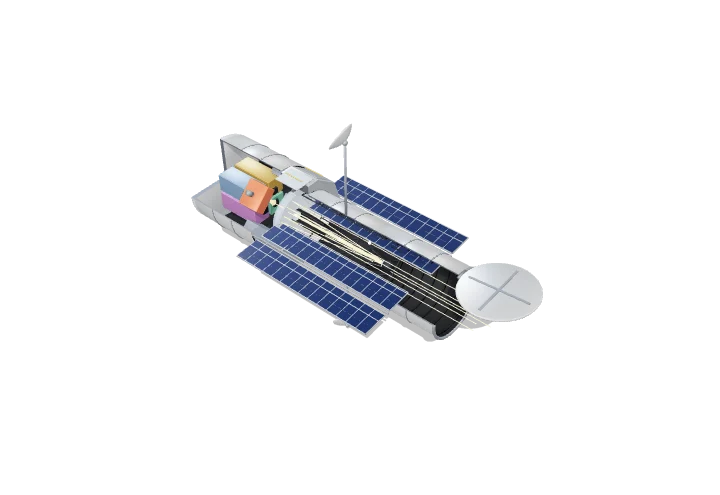 Open the interactive 3D model →
Why put a telescope the size of a school bus into orbit when there are bigger ones on mountaintops?
The Hubble Space Telescope has circled Earth about 500 km up since 1990. Up there it is above the air, which blurs starlight and blocks ultraviolet light, so it takes very sharp pictures. Inside, two mirrors bounce starlight back and forth to focus it onto cameras that astronauts upgraded on five visits.
The Hubble Space Telescope is a 2.4 m Ritchey–Chrétien reflector in low Earth orbit, launched in 1990 and serviced by astronauts five times. Above the atmosphere it delivers sharp, diffraction-limited images from the ultraviolet to the near-infrared, feeding a suite of interchangeable cameras and spectrographs.
Key facts
- Launched
- 24 April 1990 (STS-31, Discovery)
- Length × diameter
- 13.2 m × 4.2 m
- Mass
- ≈ 11,100 kg
- Primary mirror
- 2.4 m, f/2.3; system f/24, focal length 57.6 m
- Wavelength range
- ≈ 0.1–2.5 µm (UV to near-IR)
- Orbit
- ≈ 500–540 km altitude, ~95 min period, 28.5° inclination
Parts you can explore (13)
- Aperture door
- Light shield
- Forward shell
- Primary mirror
- Secondary mirror
- Baffles
- Light path
- Equipment section
- Aft shroud
- Science instruments
- Fine guidance sensors
- Solar arrays
- High-gain antennas
In the 3D model
Rotate and take apart the model, follow a guided tour of what each part does and why it’s needed, change it with a live slider, and test yourself with a short quiz. Free, no sign-up.
Open Hubble Space Telescope in 3D →
OpenArc Models’ models are simplified teaching schematics. Terms · Privacy