Plants & animals
Honeybee
Insects · Anatomy
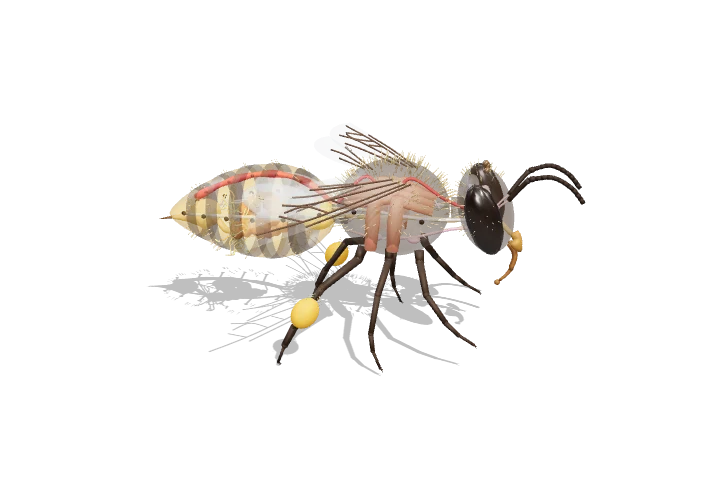 Open the interactive 3D model →
How does a bee beat its wings 230 times a second and still find its way home?
A worker honeybee is a flying collector: its eyes and antennae find flowers, its wings carry it kilometres from the hive, and its body carries home sweet nectar and protein-rich pollen. Inside, it breathes through tiny air tubes instead of lungs, and a long tube-shaped heart moves its blood.
The worker honeybee is an insect built for foraging: its head carries eyes and antennae tuned to flowers, its thorax is almost entirely flight muscle driving two pairs of coupled wings at about 230 beats per second, and its legs collect pollen. Inside, a honey stomach carries nectar, a tubular heart moves haemolymph through an open circulation, and tracheae deliver air straight to the tissues.
Key facts
- Body length (worker)
- ≈ 12–15 mm
- Body mass (worker)
- ≈ 80–120 mg, unladen
- Wingbeat frequency
- ≈ 230 Hz, stroke amplitude ≈ 90°
- Flight speed
- ≈ 6–8 m s⁻¹ (about 25 km h⁻¹)
- Brain
- ≈ 1 million neurons in about 1 mm³
- Summer worker lifespan
- ≈ 5–6 weeks
Parts you can explore (16)
- Head
- Compound eyes
- Ocelli
- Antennae
- Mouthparts
- Thorax and flight muscles
- Wings
- Legs
- Pollen baskets
- Abdomen
- Sting
- Brain
- Digestive tract
- Honey stomach
- Tracheae and air sacs
- Dorsal vessel (heart)
In the 3D model
Rotate and take apart the model, follow a guided tour of what each part does and why it’s needed, change it with a live slider, and test yourself with a short quiz. Free, no sign-up.
OpenArc Models’ models are simplified teaching schematics. Terms · Privacy