Cells & molecules
HIV-1 virion
Virology · Retrovirus
 Open the interactive 3D model →
Why can HIV be controlled with daily tablets but not yet cured?
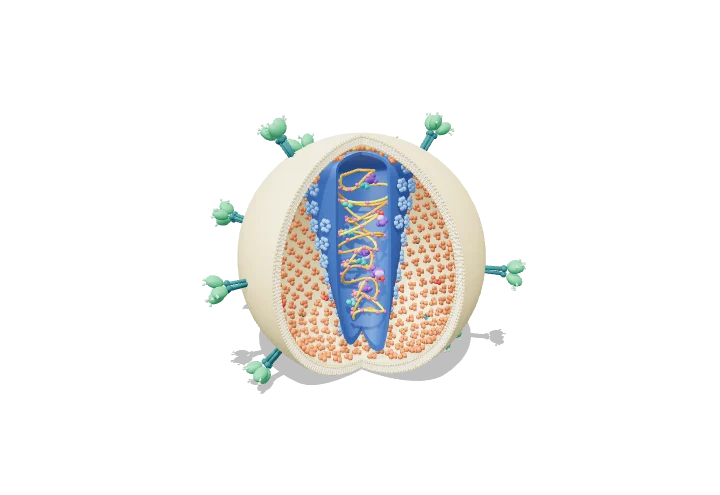
HIV is a virus about 120 nm across, wrapped in a fatty coat with a few spikes on its surface. Inside sits a cone-shaped protein shell holding two copies of its genetic material, written in RNA, plus the enzymes it needs. Those enzymes copy the RNA into DNA and paste it into the DNA of the cell it infects — which is why the infection becomes permanent, even though modern medicines can stop the virus multiplying.
HIV-1 is an enveloped retrovirus whose mature particle carries two copies of a positive-sense RNA genome, together with reverse transcriptase and integrase, inside a cone-shaped protein capsid. After entry the RNA is copied into DNA and permanently inserted into the host genome, which is why infection persists for life without treatment.
Key facts
- Virion diameter
- ≈ 100–140 nm
- Genome
- 2 × ~9.7 kb (+)ssRNA, 9 genes
- Env spikes per virion
- ≈ 7–14 (mean ~14)
- Capsid
- ≈ 250 CA hexamers + 12 pentamers (~1,500 CA)
- Gag per immature particle
- ≈ 2,400 (estimates vary)
- Main target cells
- CD4⁺ T cells, macrophages
Parts you can explore (11)
- Lipid envelope
- gp120 (surface)
- gp41 (transmembrane)
- Matrix (p17)
- Capsid (p24)
- RNA genome
- Nucleocapsid (p7)
- Reverse transcriptase
- Integrase
- Protease
- Immature Gag lattice
In the 3D model
Rotate and take apart the model, follow a guided tour of what each part does and why it’s needed, change it with a live slider, and test yourself with a short quiz. Free, no sign-up.
OpenArc Models’ models are simplified teaching schematics. Terms · Privacy