Human body
Hip joint
Anatomy · Ball-and-socket joint
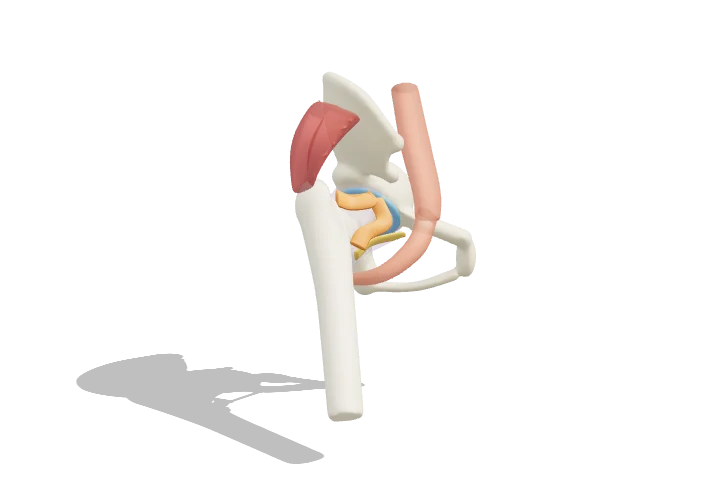 Open the interactive 3D model →
Why can your hip carry three times your body weight with every step, yet still let you kick high?
Your hip is a ball-and-socket joint: the round top of your thigh bone (the femoral head) sits in a deep cup in your pelvis. The ball can swing forwards, backwards, sideways and twist, all about one fixed centre. Tough ligaments and strong muscles keep it snug even when you run or jump.
The hip is a ball-and-socket synovial joint between the femoral head and the acetabulum of the hip bone, built for stability under loads of several times body weight. A deep socket, a fibrocartilage labrum, three spiralling capsular ligaments and powerful muscles let it move in three planes while carrying the trunk.
Key facts
- Joint type
- Synovial ball-and-socket (spheroidal), 3 rotational degrees of freedom
- Femoral head diameter
- ≈ 40–55 mm (≈ 48 mm typical adult male)
- Neck–shaft angle
- ≈ 125–135° in adults (≈ 150° at birth)
- Femoral anteversion
- ≈ 10–15° in adults
- Range of motion
- Flexion ≈ 120°, extension ≈ 20°, abduction ≈ 45°, adduction ≈ 30°
- Joint force, walking
- ≈ 2.5–3 × body weight
Parts you can explore (11)
- Hip bone
- Femur
- Articular cartilage
- Acetabular labrum
- Ligamentum teres
- Joint capsule
- Iliofemoral ligament
- Pubofemoral ligament
- Ischiofemoral ligament
- Gluteus medius
- Iliopsoas
In the 3D model
Rotate and take apart the model, follow a guided tour of what each part does and why it’s needed, change it with a live slider, and test yourself with a short quiz. Free, no sign-up.
OpenArc Models’ models are simplified teaching schematics. Terms · Privacy