Fluids & heat
Vapour-compression heat pump
Thermal · Refrigeration cycle
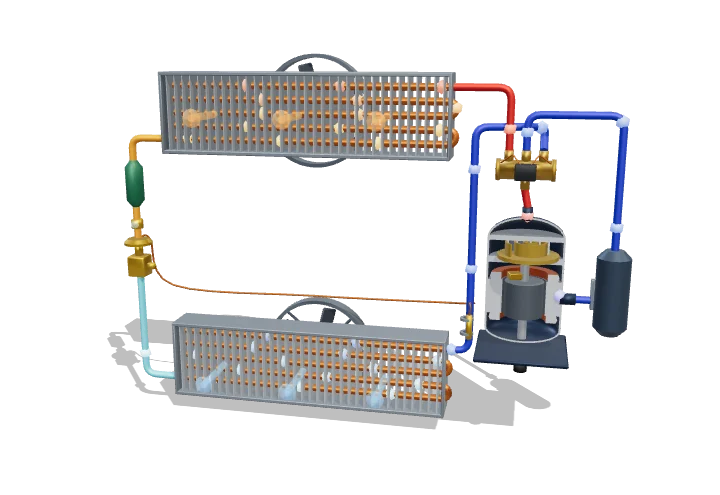 Open the interactive 3D model →
How can a machine heat your house with air from outside that is colder than your freezer?
A heat pump moves heat instead of making it. A special fluid, the refrigerant, boils at very low temperatures, so even freezing outdoor air can warm it up. A pump called the compressor then squeezes the vapour until it is hotter than your room, and it gives that heat to the house.
A vapour-compression heat pump moves heat from a cold place to a warm one by circulating a refrigerant that boils at low pressure in the evaporator, absorbing heat, and condenses at high pressure in the condenser, releasing it. The compressor supplies the work that makes this “uphill” heat flow possible, and because it moves heat rather than generating it, a heat pump typically delivers three to four times as much heat as the electrical energy it uses.
Key facts
- Ideal cycle
- Vapour compression: compress, condense, throttle, evaporate
- Heat-pump COP (air source)
- ≈ 2.5–4.5 (seasonal average ≈ 3)
- Carnot COP, 0 °C → 35 °C
- ≈ 8.8
- Identity
- COP_HP = COP_R + 1
- R-410A pressures
- ≈ 0.8 MPa evaporating at 0 °C; ≈ 2.7 MPa condensing at 45 °C
- Superheat at evaporator exit
- ≈ 4–8 K (set by the expansion valve)
Parts you can explore (12)
- Compressor
- Condenser
- Condenser fan
- Expansion valve
- Evaporator
- Evaporator fan
- Reversing valve
- Filter-drier
- Sensing bulb
- Suction accumulator
- Piping
- Refrigerant flow
In the 3D model
Rotate and take apart the model, follow a guided tour of what each part does and why it’s needed, change it with a live slider, and test yourself with a short quiz. Free, no sign-up.
Open Vapour-compression heat pump in 3D →
OpenArc Models’ models are simplified teaching schematics. Terms · Privacy