Fluids & heat
Heat pipe
Heat transfer · Two-phase cooling
 Open the interactive 3D model →
How does a thin copper tube with no moving parts carry heat away from a laptop chip faster than solid copper?
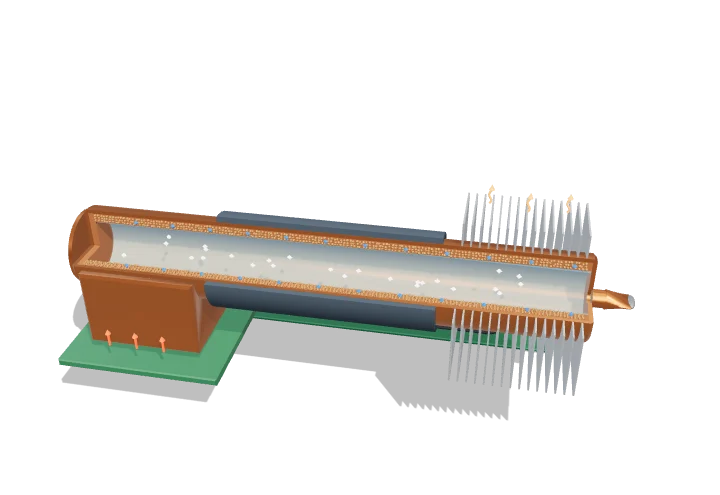
A heat pipe is a sealed copper tube with the air sucked out and a few drops of water inside. At the hot end the water boils into vapour, which rushes to the cool end, turns back into water and gives up its heat. A spongy lining then soaks the water back to the hot end, ready to go round again.
A heat pipe is a sealed, evacuated tube containing a small charge of working fluid that evaporates at the hot end, flows as vapour to the cold end, condenses, and returns through a capillary wick. Because heat travels as latent heat at nearly constant temperature, a heat pipe’s effective thermal conductivity can be tens to hundreds of times that of solid copper.
Key facts
- Typical laptop pipe
- 6–8 mm diameter, 150–300 mm long, ≈ 20–60 W each
- Effective conductivity
- ≈ 10 000–100 000 W/(m·K) vs 400 for copper
- Water latent heat (50 °C)
- ≈ 2.38 MJ/kg
- Internal pressure (water, 50 °C)
- ≈ 12 kPa (0.12 bar)
- Evaporator–condenser ΔT
- typically a few kelvin at rated load
- Wick pore radius
- ≈ 10–100 µm (sintered powder)
Parts you can explore (10)
- Copper envelope
- Wick
- Working fluid
- Vapour core
- Evaporator
- Adiabatic section
- Condenser fins
- End cap and fill tube
- Laptop heat-pipe module
- Laptop blower fan
In the 3D model
Rotate and take apart the model, follow a guided tour of what each part does and why it’s needed, change it with a live slider, and test yourself with a short quiz. Free, no sign-up.
OpenArc Models’ models are simplified teaching schematics. Terms · Privacy