Electromagnetism & electronics
Hard disk drive
Electronics · Data storage
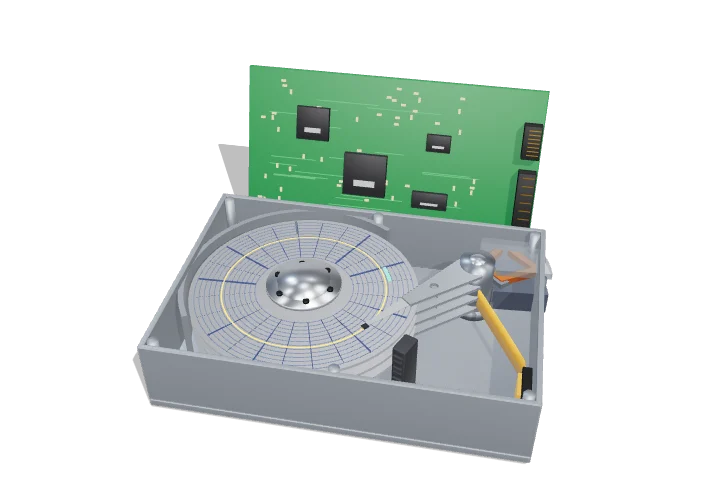 Open the interactive 3D model →
How can a spinning disk hold 20 terabytes, with a head that flies closer to it than the width of a virus?
A hard drive stores information as millions of tiny magnetised spots on shiny disks that spin 120 times a second. A swinging arm moves a head over the right ring of spots, then waits for the right spot to come round. The head floats on a cushion of air just a few nanometres thick, reading and writing the spots without ever touching them.
A hard disk drive stores bits as the magnetisation direction of tiny regions in a thin film on spinning platters, written and read by heads that fly nanometres above the surface. A voice-coil actuator swings the heads to the right track, and the platter’s rotation brings the wanted sector beneath them.
Key facts
- Form factor (shown)
- 3.5 inch; platters ≈ 95 mm across
- Spindle speed
- 7200 rpm = 120 rev/s (8.33 ms per turn)
- Average rotational latency
- 4.17 ms at 7200 rpm
- Average seek time
- ≈ 8–9 ms (desktop 7200 rpm drives)
- Head flying height
- A few nanometres
- Sector size
- 4096 bytes (Advanced Format)
Parts you can explore (10)
- Platters
- Spindle motor
- Tracks and sectors
- Actuator arm
- Read/write heads
- Voice-coil actuator
- Flex cable
- Parking ramp
- Base casting
- Controller board
In the 3D model
Rotate and take apart the model, follow a guided tour of what each part does and why it’s needed, change it with a live slider, and test yourself with a short quiz. Free, no sign-up.
OpenArc Models’ models are simplified teaching schematics. Terms · Privacy