Human body
Hand and wrist bones
Anatomy · Skeleton of the hand
 Open the interactive 3D model →
If your fingers have no muscles inside them, what actually bends them?
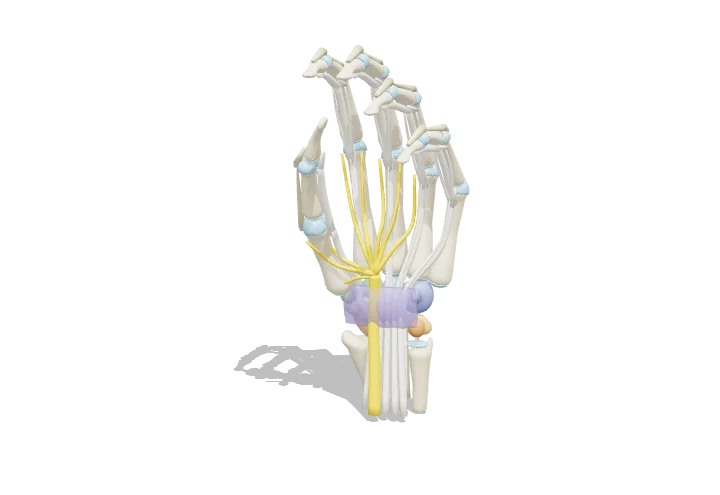
Each hand and wrist has 27 bones: eight small wrist bones, five long bones in the palm and fourteen finger bones. Muscles in your forearm pull on long cords called tendons that run through a narrow tunnel at the wrist to reach the fingers. That is why you can feel your forearm move when you wiggle your fingers.
The hand and wrist contain 27 bones — eight carpals in two rows, five metacarpals and fourteen phalanges — linked by joints that let the fingers fold into a fist or pinch with precision. Long flexor and extensor tendons from forearm muscles move them, and on the palmar side nine flexor tendons and the median nerve share the narrow carpal tunnel.
Key facts
- Bones per hand and wrist
- 27 (8 carpals, 5 metacarpals, 14 phalanges), plus small sesamoids
- Joints per finger
- 3 (MCP, PIP, DIP); thumb 2 + the saddle-shaped CMC
- Typical active flexion
- MCP ≈ 90°, PIP ≈ 100–110°, DIP ≈ 80–90°
- Carpal tunnel contents
- 9 flexor tendons + median nerve
- Carpal tunnel cross-section
- ≈ 1.5–2 cm² at its narrowest
- Adult grip strength
- ≈ 300–500 N (men), ≈ 200–300 N (women)
Parts you can explore (12)
- Proximal carpal row
- Distal carpal row
- Metacarpals
- Proximal phalanges
- Middle phalanges
- Distal phalanges
- Radius and ulna
- Articular cartilage
- Flexor tendons
- Extensor tendons
- Flexor retinaculum
- Median nerve
In the 3D model
Rotate and take apart the model, follow a guided tour of what each part does and why it’s needed, change it with a live slider, and test yourself with a short quiz. Free, no sign-up.
Open Hand and wrist bones in 3D →
OpenArc Models’ models are simplified teaching schematics. Terms · Privacy