Chemistry
Haber–Bosch process
Industrial chemistry · Equilibrium & catalysis
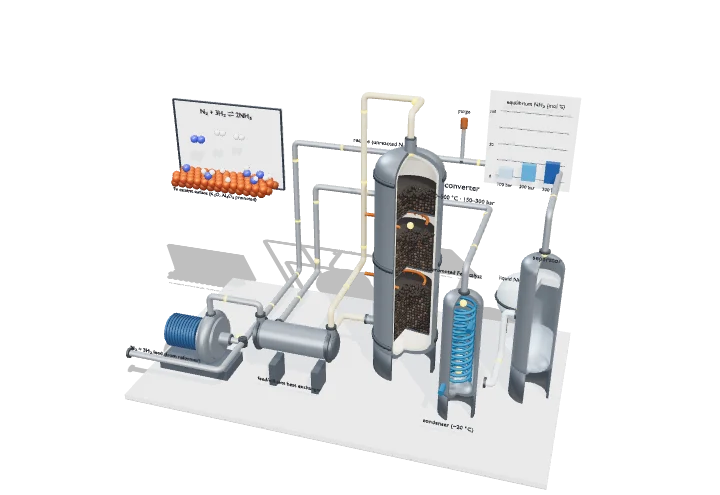 Open the interactive 3D model →
How does half the food on Earth depend on pulling nitrogen out of thin air?
Plants need nitrogen to grow, and the air is 78% nitrogen — but it is locked in molecules too tough for crops to use. The Haber–Bosch process squeezes nitrogen and hydrogen together over hot iron to make ammonia, which becomes fertiliser. Any gas that does not react is sent round again, so almost nothing is wasted.
The Haber–Bosch process combines nitrogen from air with hydrogen over an iron catalyst at about 400–500 °C and 150–300 bar to make ammonia, the starting point of almost all synthetic fertiliser. Because the reaction is exothermic and reduces the number of gas molecules, plants balance equilibrium yield against rate and recycle the unreacted gas around a loop.
Key facts
- Reaction
- N₂ + 3H₂ ⇌ 2NH₃, ΔH° = −92 kJ/mol
- Typical conditions
- 400–500 °C, 150–300 bar
- Catalyst
- Fe (from Fe₃O₄) promoted with K₂O, Al₂O₃, CaO
- Conversion per pass
- ≈ 15–25 %
- Overall conversion (with recycle)
- > 97 %
- World production
- ≈ 180 million tonnes NH₃ per year
Parts you can explore (15)
- Plant skid
- Compressor
- Heat exchanger
- Ammonia converter
- Iron catalyst beds
- Interbed quench
- Condenser
- Ammonia separator
- Liquid ammonia
- Recycle loop
- Process piping
- Synthesis-gas feed
- Gas flow
- Catalyst surface (inset)
- Equilibrium yield chart
In the 3D model
Rotate and take apart the model, follow a guided tour of what each part does and why it’s needed, change it with a live slider, and test yourself with a short quiz. Free, no sign-up.
Open Haber–Bosch process in 3D →
OpenArc Models’ models are simplified teaching schematics. Terms · Privacy