Physics
Gyroscope precession
Mechanics · Rotational dynamics
 Open the interactive 3D model →
Why does a spinning wheel held at one end swing slowly round instead of falling down?
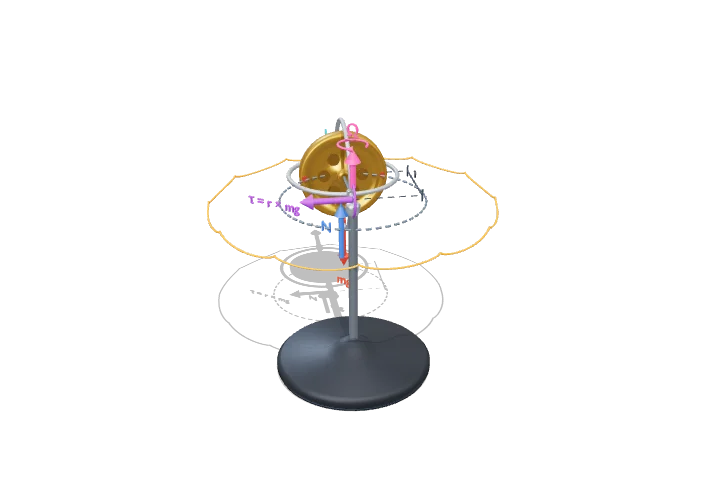
A wheel that is not spinning, held up at only one end, simply flops down. Spin it fast and gravity can no longer tip it down — instead it makes the wheel’s axle swing slowly around in a circle. This sideways swing is called precession.
A gyroscope supported at one end does not topple because gravity’s torque about the pivot is perpendicular to the rotor’s angular momentum, so it changes the direction of L rather than its size. The axle therefore sweeps around the vertical at the precession rate Ω = mgr/(I_s ω), slower the faster the rotor spins.
Key facts
- Rotational second law
- τ = dL/dt (vectors)
- Steady precession rate
- Ω = mgr / (I_s ω)
- Model gyroscope
- m = 1.2 kg, r = 12.5 cm, I_s = 4.0 × 10⁻³ kg·m²
- Gravity torque in the model
- τ = mgr ≈ 1.47 N·m
- At 2000 rpm
- L ≈ 0.84 kg·m²/s, Ω ≈ 1.76 rad/s (one turn ≈ 3.6 s)
- Earth’s axial precession
- one cycle ≈ 25 800 years
Parts you can explore (12)
- Rotor
- Gimbal frame
- Spin axle
- Pivot and stand
- Angular momentum L
- Lever arm r
- Weight mg
- Support force N
- Gravity torque τ
- Precession Ω
- Precession path
- Nutation trace
In the 3D model
Rotate and take apart the model, follow a guided tour of what each part does and why it’s needed, change it with a live slider, and test yourself with a short quiz. Free, no sign-up.
Open Gyroscope precession in 3D →
OpenArc Models’ models are simplified teaching schematics. Terms · Privacy