Earth & space
Greenhouse effect
Earth science · Climate
 Open the interactive 3D model →
Carbon dioxide is only 0.04 % of the air — so how can it change the temperature of a whole planet?
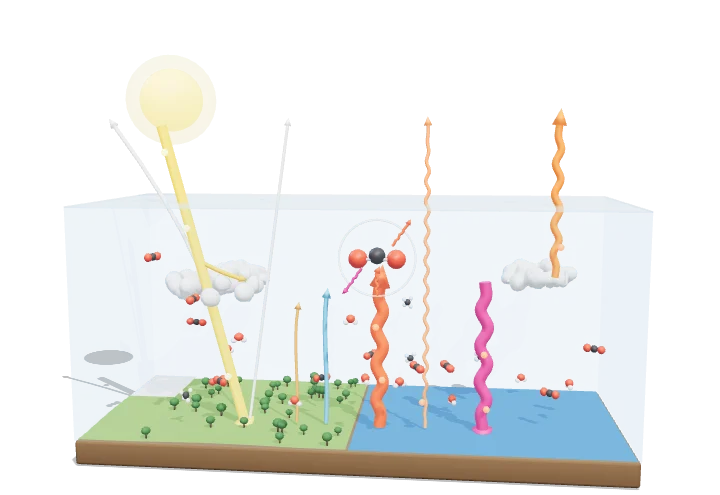
Sunlight passes through the air and warms the ground. The warm ground then gives off invisible heat rays (infrared). A few gases in the air, such as water vapour and carbon dioxide, catch those heat rays and send some back down, keeping Earth about 33 °C warmer than it would otherwise be.
Earth’s surface is about 33 K warmer than it would be without greenhouse gases because water vapour, carbon dioxide, methane and clouds absorb the infrared radiation emitted by the surface and re-emit part of it back downward. Adding CO₂ makes the atmosphere more opaque to infrared, raising the effective emission level to colder altitudes and creating a radiative forcing of about 5.35 ln(C/C₀) W/m².
Key facts
- Incoming solar radiation (global mean)
- ≈ 340 W/m²
- Planetary albedo
- ≈ 0.29–0.30
- Effective emission temperature
- ≈ 255 K (−18 °C)
- Mean surface temperature
- ≈ 288 K (15 °C)
- Back radiation to the surface
- ≈ 340 W/m²
- Forcing for doubled CO₂
- ≈ 3.7–3.9 W/m²
Parts you can explore (13)
- Sun
- Incoming sunlight
- Reflected sunlight
- Clouds
- Earth surface
- Atmosphere
- Surface infrared emission
- Atmospheric window
- Back radiation
- Outgoing infrared
- Sensible and latent heat
- Greenhouse gas molecules
- CO₂ vibration close-up
In the 3D model
Rotate and take apart the model, follow a guided tour of what each part does and why it’s needed, change it with a live slider, and test yourself with a short quiz. Free, no sign-up.
Open Greenhouse effect in 3D →
OpenArc Models’ models are simplified teaching schematics. Terms · Privacy