Astronomy & space
GPS constellation
Spaceflight · Satellite navigation
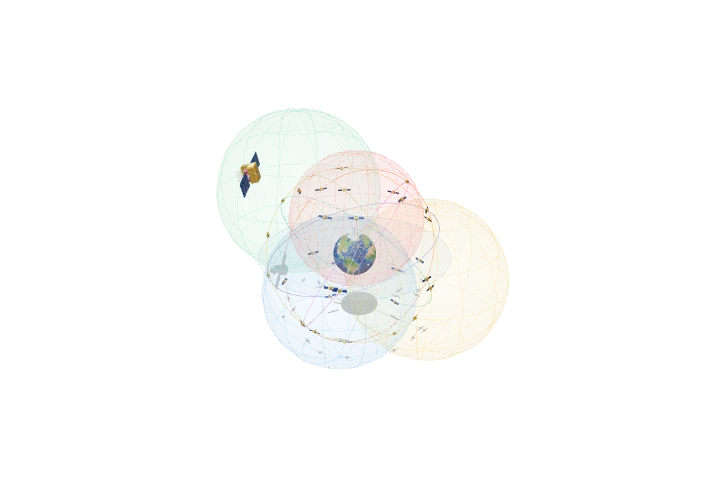 Open the interactive 3D model →
How does your phone know where you are to within a few metres — without ever sending a signal to space?
About 30 GPS satellites circle Earth, each carrying extremely accurate atomic clocks and constantly broadcasting the time and its own position. Your phone only listens: it measures how long each signal took to arrive, which tells it how far away each satellite is. With distances to four satellites it can work out exactly where it is — but only because the satellites’ clocks are corrected for Einstein’s relativity.
The Global Positioning System is a constellation of about 30 satellites in six orbital planes, each broadcasting precise time from atomic clocks together with its own orbit. A receiver turns the signal travel times from four or more satellites into its position and clock offset — and the whole system works only because the satellite clocks are corrected for special and general relativity.
Key facts
- Orbit
- ≈ 20,200 km altitude (a = 26,560 km), 55° inclination
- Orbital period
- 11 h 58 min (half a sidereal day)
- Constellation
- 6 planes; baseline 24 satellites, ≈ 31 operational
- Signals
- L1 1575.42 MHz, L2 1227.60 MHz, L5 1176.45 MHz
- Relativistic clock offset
- ≈ +38 µs/day (GR +45.7, SR −7.2)
- Light travel time to user
- ≈ 67–86 ms
Parts you can explore (9)
- Earth
- Equatorial plane
- Orbital planes
- GPS satellites
- Ground receiver
- Signal paths
- Trilateration spheres
- Control segment
- GPS III satellite (enlarged)
In the 3D model
Rotate and take apart the model, follow a guided tour of what each part does and why it’s needed, change it with a live slider, and test yourself with a short quiz. Free, no sign-up.
Open GPS constellation in 3D →
OpenArc Models’ models are simplified teaching schematics. Terms · Privacy