Chemistry
Glucose ring closure
Biochemistry · Carbohydrates
 Open the interactive 3D model →
Why does the sugar in your blood spend almost all its time curled up into a ring?
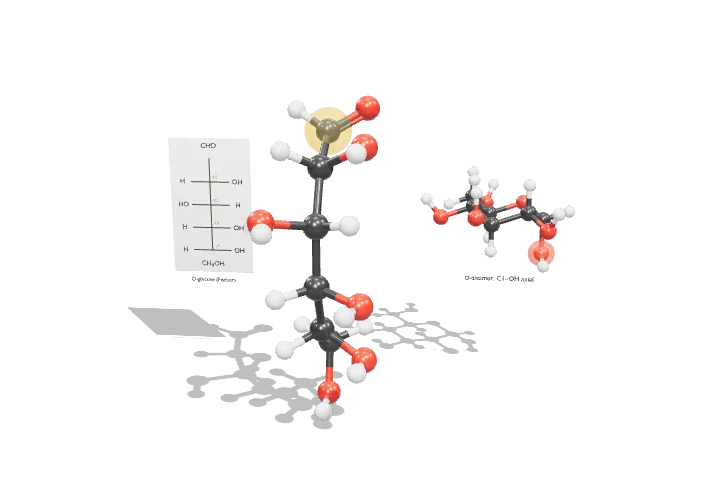
Glucose is a chain of six carbon atoms with an oxygen-rich group at one end. In water the chain bends round so that an oxygen near its far end bonds to the first carbon, closing a ring of six atoms. Over 99% of glucose in your body is in this ring form at any moment.
D-glucose exists in water almost entirely as six-membered rings formed when the C5 hydroxyl oxygen adds to the C1 aldehyde, giving a cyclic hemiacetal with a new stereocentre at C1. The two resulting anomers interconvert through the open chain (mutarotation); β-D-glucopyranose, with every substituent equatorial on a chair, makes up about 64% of the mixture and α about 36%.
Key facts
- Formula
- C₆H₁₂O₆, M = 180.16 g mol⁻¹
- Stereocentres
- 4 in the open chain (C2–C5); 5 in the ring (adds C1)
- Equilibrium in water (25 °C)
- ≈ 64% β-pyranose, 36% α-pyranose, < 1% furanoses; open-chain aldehyde only ≈ 0.002%
- Specific rotation
- α +112°, β +18.7°, equilibrium +52.7°
- Ring conformation
- ⁴C₁ chair; in β all OH and CH₂OH equatorial
- Blood glucose (fasting)
- ≈ 3.9–5.5 mM (70–100 mg dL⁻¹)
Parts you can explore (10)
- Carbon atoms
- Oxygen atoms
- Hydrogen atoms
- Covalent bonds
- Aldehyde C=O (π bond)
- Hemiacetal bond (C1–O5)
- Anomeric carbon (C1)
- Equatorial OH highlights
- α-D-glucopyranose (comparison)
- Fischer projection card
In the 3D model
Rotate and take apart the model, follow a guided tour of what each part does and why it’s needed, change it with a live slider, and test yourself with a short quiz. Free, no sign-up.
Open Glucose ring closure in 3D →
OpenArc Models’ models are simplified teaching schematics. Terms · Privacy