Earth & space
Glacier
Earth science · Glaciology
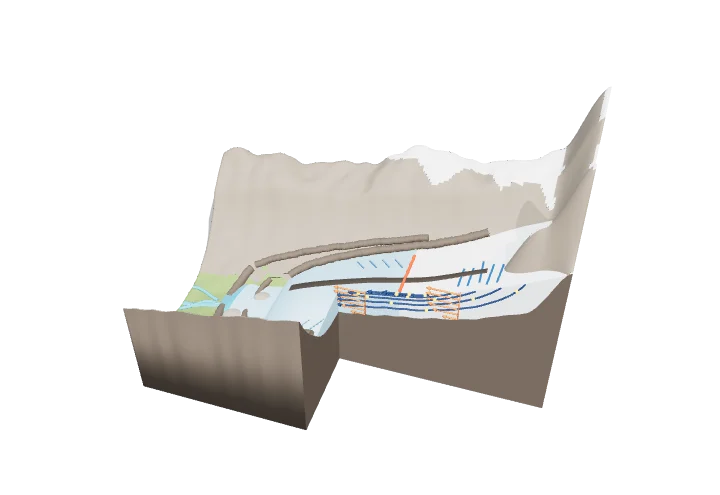 Open the interactive 3D model →
How can solid ice flow downhill like a river — and why do glaciers shrink even while they keep moving forward?
A glacier is a huge body of ice that builds up from snow high in the mountains. Its own weight makes it creep slowly downhill, a few centimetres to a metre a day, until it reaches warmer air lower down and melts. If more melts than snow arrives, the glacier shrinks back up its valley, even though the ice is still flowing down.
A valley glacier is a body of ice that gains mass by snowfall in its accumulation zone and loses it by melt in its ablation zone, while flowing downhill under its own weight to carry the surplus between them. Its size adjusts to climate, and the landforms it leaves — U-shaped valleys, moraines, striated bedrock — record where it has been.
Key facts
- Density: snow → firn → ice
- ≈ 50–300 → 400–830 → 830–917 kg/m³
- Typical surface speed (alpine)
- ≈ 10–200 m/yr; fast outlet glaciers > 10 km/yr
- Accumulation-area ratio (steady state)
- ≈ 0.55–0.65
- Crevasse depth
- usually ≤ 30–40 m
- Glen’s flow-law exponent
- n ≈ 3
- Land area covered by ice today
- ≈ 10% (≈ 15 million km²)
Parts you can explore (11)
- Accumulation zone
- Equilibrium line
- Ablation zone
- Crevasses
- Internal ice flow
- Lateral moraines
- Medial moraine
- Terminal moraine
- Meltwater
- Striated bedrock
- U-shaped valley
In the 3D model
Rotate and take apart the model, follow a guided tour of what each part does and why it’s needed, change it with a live slider, and test yourself with a short quiz. Free, no sign-up.
OpenArc Models’ models are simplified teaching schematics. Terms · Privacy