Earth & space
Geyser
Earth science · Hydrothermal systems
 Open the interactive 3D model →
Why does a geyser shoot water 50 m into the air while the hot spring next to it just steams?
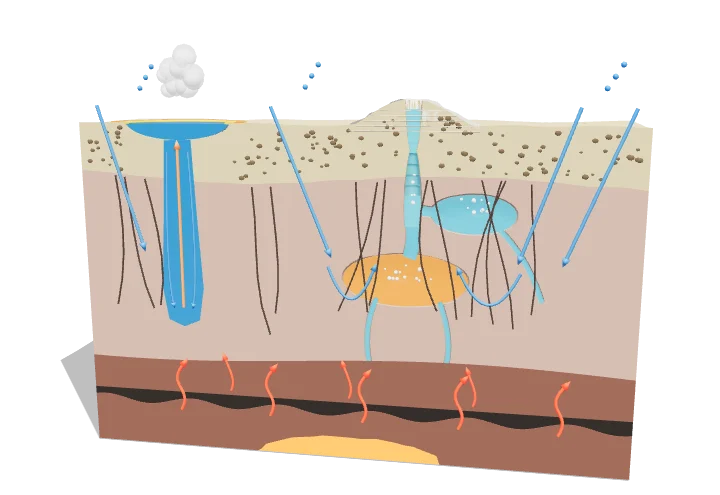
Rain soaks into the ground and trickles down to rock heated by magma far below. Deep in a narrow underground pipe, the weight of the water above lets it get hotter than boiling without turning to steam. When a little water spills out at the top, that weight drops, the hot water suddenly flashes into steam and blasts out.
A geyser is a hot spring whose narrow, constricted plumbing lets water heat above its surface boiling point under the pressure of the water above it. When boiling near the top expels some water, the pressure on the superheated water below drops, it flashes to steam, and the column erupts.
Key facts
- Active geysers worldwide
- ≈ 1000; about half in Yellowstone
- Boiling point at Yellowstone’s surface
- ≈ 92–93 °C (≈ 2200–2400 m elevation)
- Old Faithful interval
- ≈ 60–110 min (mean ≈ 90 min)
- Old Faithful eruption height
- ≈ 30–55 m, lasting 1.5–5 min
- Temperature measured 22 m down Old Faithful
- ≈ 118 °C before eruption
- Volume increase on vaporisation (1 atm)
- ≈ 1600 ×
Parts you can explore (10)
- Magma heat source
- Porous rock
- Groundwater recharge
- Water reservoir chambers
- Superheated water
- Constricted conduit
- Steam bubbles
- Sinter mound
- Eruption column
- Hot spring pool
In the 3D model
Rotate and take apart the model, follow a guided tour of what each part does and why it’s needed, change it with a live slider, and test yourself with a short quiz. Free, no sign-up.
OpenArc Models’ models are simplified teaching schematics. Terms · Privacy