Power & energy
Geothermal power plant
Renewable energy · Flash-steam plant
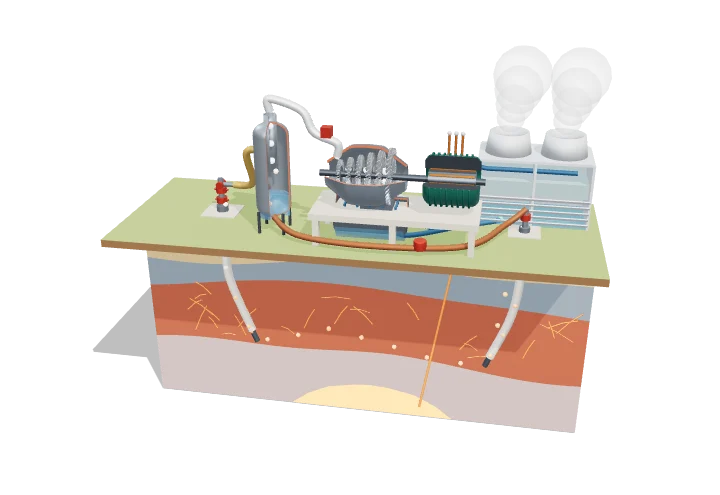 Open the interactive 3D model →
How can heat from deep underground keep the lights on day and night?
In some places, hot rock a few kilometres down heats water trapped in cracks underground to well over 200 °C. Wells bring this water up, and as it rises part of it bursts into steam that spins a turbine to make electricity. The leftover hot water is pumped back down so the underground supply lasts.
A flash-steam geothermal plant taps a hydrothermal reservoir of hot pressurised water, lets part of it boil (flash) as the pressure falls, and drives a turbine with the separated steam before returning the brine underground. It delivers steady, low-carbon power around the clock, but because its heat source is only 200–300 °C its thermal efficiency is low and its output depends strongly on reservoir temperature.
Key facts
- Reservoir temperature (flash plants)
- ≈ 180–320 °C
- Reservoir depth
- ≈ 1–3 km
- Steam fraction flashed
- ≈ 10–30 % of well flow
- Thermal efficiency
- ≈ 10–17 %
- Unit size
- ≈ 20–110 MWe
- Worldwide installed capacity
- ≈ 16 GW (early 2020s)
Parts you can explore (9)
- Geological strata
- Production well
- Separator
- Steam turbine
- Generator
- Condenser
- Cooling tower
- Reinjection well
- Geothermal fluid flow
In the 3D model
Rotate and take apart the model, follow a guided tour of what each part does and why it’s needed, change it with a live slider, and test yourself with a short quiz. Free, no sign-up.
Open Geothermal power plant in 3D →
OpenArc Models’ models are simplified teaching schematics. Terms · Privacy