Mechanisms
Geneva drive
Mechanisms · Intermittent motion
 Open the interactive 3D model →
How does an old film projector hold each picture perfectly still, 24 times every second?
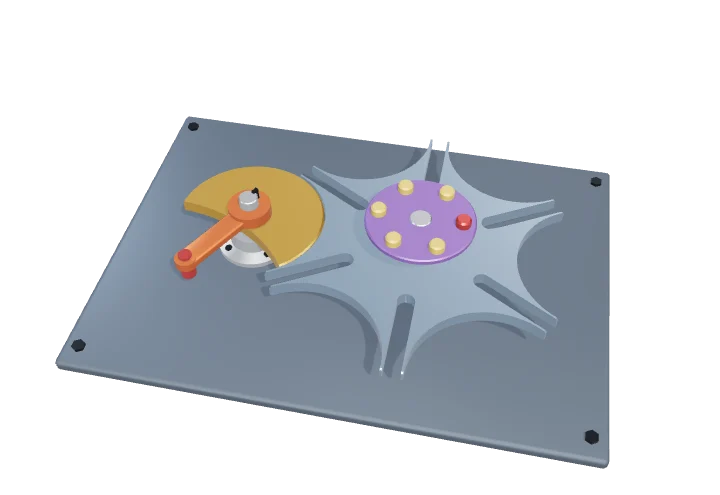
A Geneva drive turns a smooth, steady spin into a stop–go motion. A pin on a spinning arm drops into a slot of a star-shaped wheel, pushes it round by one slot, and slides out again. Then a round disc locks the wheel still until the pin comes back.
A Geneva drive turns continuous rotation of a crank into intermittent rotation of a slotted wheel: each crank revolution advances the wheel by exactly one slot pitch, 360°/n, and a locking disc holds the wheel stationary for the rest of the turn. With the crank radius chosen as C·sin(π/n), the pin enters and leaves each slot tangentially, so the wheel starts and stops with zero velocity.
Key facts
- Step per crank revolution
- 360°/n
- Crank angle spent driving
- 180° − 360°/n
- Fraction of time moving (4 / 6 / 8 slots)
- 25 % / 33.3 % / 37.5 %
- Peak wheel speed ÷ crank speed (4 / 6 / 8)
- 2.41 / 1.00 / 0.62
- Crank radius for tangential entry
- a = C sin(π/n)
- Minimum practical slots (external)
- 3
Parts you can explore (9)
- Geneva wheel
- Locking disc
- Drive crank
- Drive pin
- Input shaft
- Output shaft
- Index table
- Bearings
- Base plate
In the 3D model
Rotate and take apart the model, follow a guided tour of what each part does and why it’s needed, change it with a live slider, and test yourself with a short quiz. Free, no sign-up.
OpenArc Models’ models are simplified teaching schematics. Terms · Privacy