Electromagnetism & electronics
AC generator (alternator)
Electromagnetism · Induction
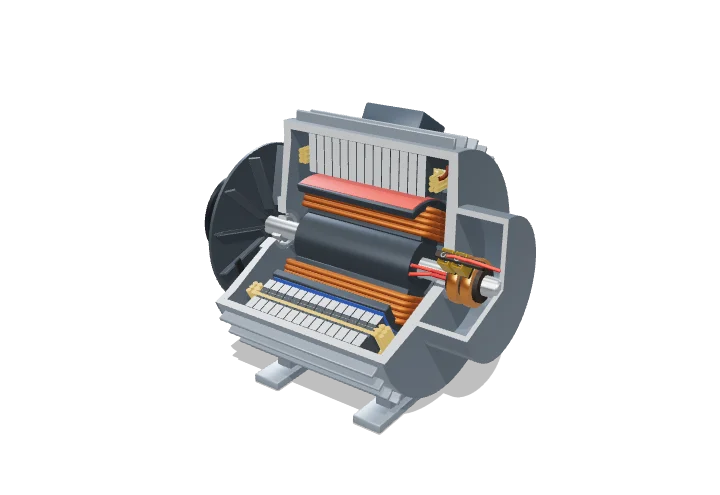 Open the interactive 3D model →
How does spinning a magnet next to some copper wire light up a whole city?
A generator turns movement into electricity. A spinning magnet sweeps past coils of copper wire, and every time the magnetic field through a coil changes, it pushes the electrons in the wire along. Because the north and south poles take turns passing each coil, the push keeps changing direction — that is alternating current, the kind in your wall sockets.
An alternator turns mechanical rotation into alternating voltage by Faraday induction: a rotating magnetic field sweeps past stationary coils, so the flux linking each coil varies sinusoidally and induces an EMF proportional to its rate of change. Output frequency is locked to shaft speed and the number of poles, and output voltage depends on speed, field strength and the number of turns.
Key facts
- Governing law
- Faraday: e = −N dΦ/dt
- Frequency
- f = p n / 120 (p poles, n in rpm)
- 2-pole grid machine
- 3,000 rpm → 50 Hz; 3,600 rpm → 60 Hz
- Large turbogenerator
- Up to ≈ 1,500–2,000 MVA, 15–27 kV at the terminals
- Efficiency
- ≈ 98.5–99% (large); ≈ 50–70% (car alternator including rectifier)
- Car alternator output
- ≈ 14 V DC after the rectifier, 70–250 A
Parts you can explore (10)
- Stator frame
- Stator core
- Stator coils
- Rotor magnet
- Slip rings & brushes
- Shaft & drive pulley
- Cooling fan
- Bearings
- End frames
- Terminal box
In the 3D model
Rotate and take apart the model, follow a guided tour of what each part does and why it’s needed, change it with a live slider, and test yourself with a short quiz. Free, no sign-up.
Open AC generator (alternator) in 3D →
OpenArc Models’ models are simplified teaching schematics. Terms · Privacy