Mechanisms
Spur gear pair
Power transmission · 2 : 1 reduction
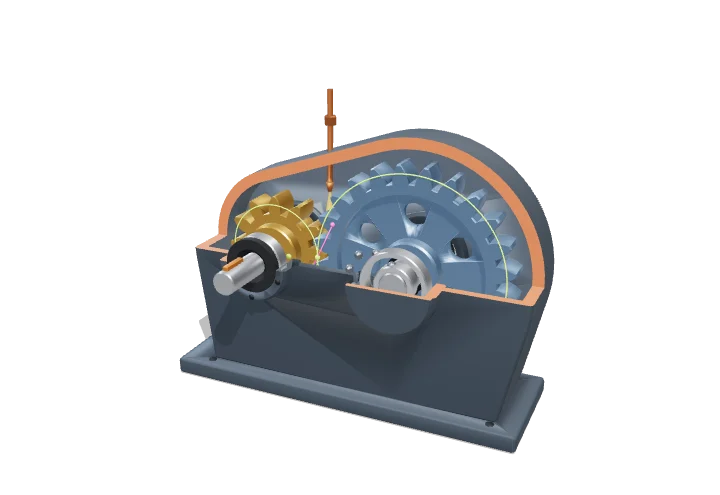 Open the interactive 3D model →
How can a small gear make a big one turn more slowly but push harder?
Two toothed wheels lock together, so when one turns the other must turn too. The big gear here has twice as many teeth, so it turns at half the speed, the opposite way, with about twice the turning force.
A spur gear pair transmits rotation between parallel shafts at a fixed speed ratio set by the tooth counts, here 24/12 = 2:1 with the output reversed. Involute tooth flanks make that ratio exactly constant through every instant of engagement, which is why almost every modern gear uses them.
Key facts
- Speed ratio (model)
- 24 / 12 = 2 : 1, output reversed
- Model gears
- module 3 mm, pitch diameters 36 and 72 mm, centre distance 54 mm
- Pressure angle
- 20° standard; 25° in the model (lets a 12-tooth pinion run without undercut)
- Mesh efficiency, spur
- ≈ 98–99% per stage
- Contact ratio
- ≈ 1.4 in the model; 1.4–1.8 typical (≥ 1.2 recommended)
- Practical single-stage ratio
- up to ≈ 6–8 : 1
Parts you can explore (11)
- Driver gear (12T)
- Driven gear (24T)
- Shafts
- Shaft keys
- Retaining rings
- Housing
- Input bearing
- Output bearing
- Shaft seals
- Lubrication nozzle
- Pitch circles & line of action
In the 3D model
Rotate and take apart the model, follow a guided tour of what each part does and why it’s needed, change it with a live slider, and test yourself with a short quiz. Free, no sign-up.
OpenArc Models’ models are simplified teaching schematics. Terms · Privacy