Power & energy
Heavy-duty gas turbine
Power generation · Brayton cycle
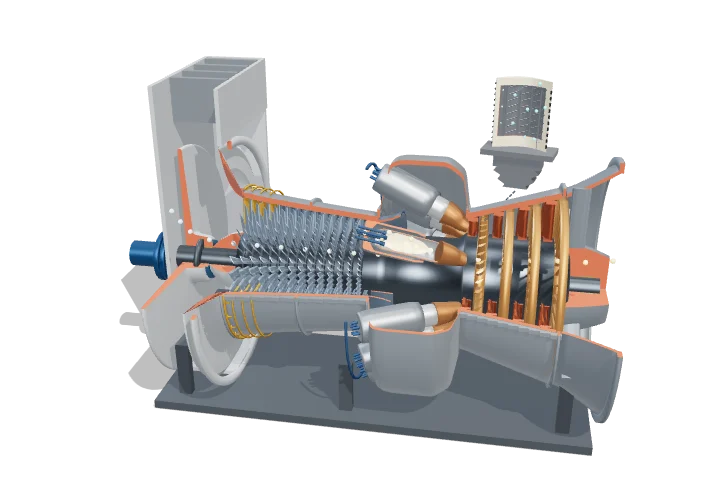 Open the interactive 3D model →
How does a power-station gas turbine turn a flame into hundreds of megawatts?
A gas turbine sucks in air, squeezes it to about twenty times normal pressure and burns natural gas in it. The hot gas rushes out through rows of blades and spins a shaft, which turns both the air-squeezing compressor and an electricity generator. It works like a jet engine, but instead of pushing a plane it turns a generator.
A heavy-duty gas turbine compresses air about twentyfold, burns natural gas in it at nearly constant pressure and expands the hot gas through a turbine that drives both the compressor and a generator. Its efficiency is governed by the Brayton cycle: pressure ratio and, in a real machine, firing temperature — which is why its first-stage blades must be cooled from the inside.
Key facts
- Unit size (large F/H class)
- ≈ 300–600 MW per machine
- Pressure ratio
- ≈ 18–24
- Firing temperature
- ≈ 1400–1600 °C (H class)
- Simple-cycle efficiency
- ≈ 38–44 % (LHV)
- Exhaust temperature
- ≈ 580–650 °C
- Shaft speed
- 3600 rpm (60 Hz) or 3000 rpm (50 Hz)
Parts you can explore (12)
- Casing
- Inlet plenum
- Variable guide vanes
- Axial compressor
- Combustors
- Turbine
- Cooled blade (inset)
- Exhaust diffuser
- Rotor
- Bearings
- Load coupling
- Gas path
In the 3D model
Rotate and take apart the model, follow a guided tour of what each part does and why it’s needed, change it with a live slider, and test yourself with a short quiz. Free, no sign-up.
Open Heavy-duty gas turbine in 3D →
OpenArc Models’ models are simplified teaching schematics. Terms · Privacy