Chemistry
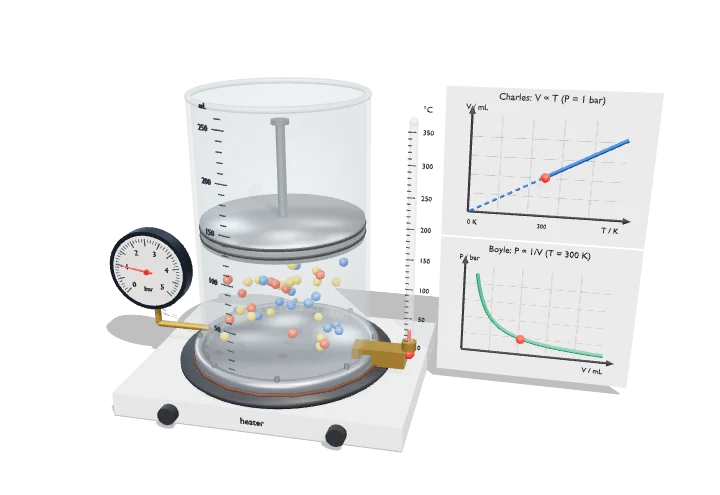
Gas laws: piston and cylinder
Physical chemistry · Ideal gases
 Open the interactive 3D model →
Why does a bicycle tyre feel harder on a hot day, and a balloon shrink in the freezer?
A gas is billions of tiny molecules zooming about and bouncing off the walls; all those hits add up to pressure. Squeeze a gas into less space and the molecules hit the walls more often. Heat it and they move faster, hit harder, and push the walls outward.
A fixed amount of gas trapped under a free piston obeys the ideal-gas law PV = nRT: at constant temperature its volume is inversely proportional to pressure (Boyle), and at constant pressure its volume is proportional to absolute temperature (Charles). Kinetic theory explains both: pressure comes from molecular collisions with the walls, and temperature measures the molecules’ average kinetic energy.
Key facts
- Gas constant R
- 8.314 J mol⁻¹ K⁻¹
- Gas in the model
- n = 5.00 mmol N₂ (≈ 3.0 × 10²¹ molecules)
- Volume at 300 K, 1.0 bar
- 124.7 mL
- Molar volume at 273.15 K, 1 bar
- 22.71 L/mol
- rms speed of N₂ at 300 K
- 517 m/s
- Absolute zero
- 0 K = −273.15 °C
Parts you can explore (9)
- Cylinder
- Piston
- Slotted weights
- Gas molecules
- Thermometer
- Pressure gauge
- Heater
- Charles’s law graph
- Boyle’s law graph
In the 3D model
Rotate and take apart the model, follow a guided tour of what each part does and why it’s needed, change it with a live slider, and test yourself with a short quiz. Free, no sign-up.
Open Gas laws: piston and cylinder in 3D →
OpenArc Models’ models are simplified teaching schematics. Terms · Privacy