Chemistry
Galvanic cell (Daniell cell)
Electrochemistry · Redox
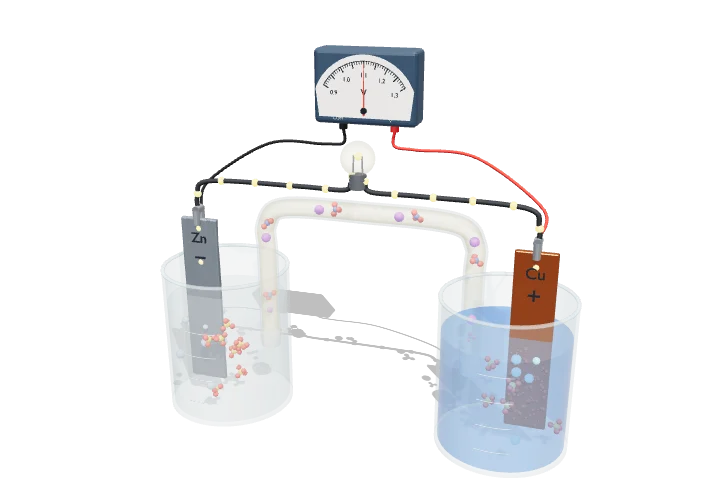 Open the interactive 3D model →
How can two pieces of metal and some salty water light a bulb?
Zinc gives up electrons more easily than copper does. Put each metal in its own beaker of solution and join them with a wire, and electrons flow from the zinc to the copper — that flow is an electric current. A salty bridge between the beakers lets charged particles move so the current can keep going.
A galvanic cell separates a spontaneous redox reaction into two half-cells so that its electrons must travel through an external circuit, turning chemical free energy into electrical work. In the Daniell cell zinc is oxidised and copper(II) is reduced, giving 1.10 V under standard conditions, and the Nernst equation shows how that voltage changes with concentration.
Key facts
- Cell notation
- Zn(s) | Zn²⁺(aq) ‖ Cu²⁺(aq) | Cu(s)
- Standard potentials
- Cu²⁺/Cu +0.34 V; Zn²⁺/Zn −0.76 V
- E°cell
- +1.10 V at 25 °C
- ΔG°
- −212 kJ per mol Zn (n = 2)
- Equilibrium constant
- K ≈ 10³⁷
- Nernst slope (n = 2)
- 29.6 mV per tenfold change in Q at 25 °C
Parts you can explore (13)
- Zinc anode
- Copper cathode
- ZnSO₄ solution
- CuSO₄ solution
- Beakers
- Salt bridge (KNO₃)
- External circuit
- Voltmeter
- Electron flow
- Salt-bridge ions
- Zn²⁺ ions
- Cu²⁺ ions
- Sulfate ions
In the 3D model
Rotate and take apart the model, follow a guided tour of what each part does and why it’s needed, change it with a live slider, and test yourself with a short quiz. Free, no sign-up.
Open Galvanic cell (Daniell cell) in 3D →
OpenArc Models’ models are simplified teaching schematics. Terms · Privacy