Power & energy
Tokamak fusion reactor
Fusion energy · Magnetic confinement
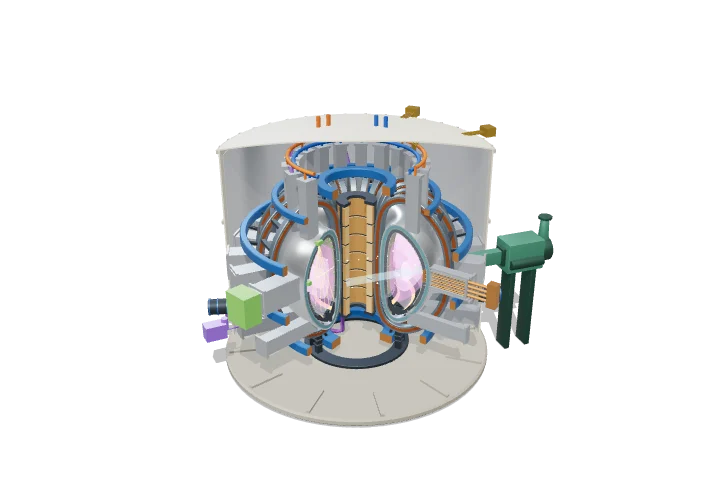 Open the interactive 3D model →
How do you hold something ten times hotter than the Sun’s core without it touching anything?
A tokamak is a doughnut-shaped machine that tries to make energy the way the Sun does, by fusing light hydrogen atoms into helium. The fuel is heated to about 150 million °C, so hot that it becomes a glowing gas called plasma. Giant magnets hold the plasma in mid-air, because no wall could survive touching it.
A tokamak confines a deuterium–tritium plasma at about 10–20 keV (over 100 million kelvin) in a doughnut-shaped magnetic cage made from a strong toroidal field plus the poloidal field of a current flowing in the plasma itself. Fusion becomes self-sustaining only when density, temperature and energy confinement time together satisfy the Lawson triple-product criterion, and every other system in the machine — magnets, blanket, divertor, heating, fuelling, diagnostics and cryostat — exists to reach or exploit that condition.
Key facts
- D–T reaction energy
- 17.6 MeV (3.5 MeV α + 14.1 MeV neutron)
- Optimum ion temperature
- ≈ 10–20 keV (≈ 120–230 million K)
- Ignition triple product
- n T τ_E ≳ 3 × 10²¹ keV s m⁻³
- ITER major / minor radius
- R ≈ 6.2 m, a ≈ 2.0 m, plasma volume ≈ 830 m³
- ITER toroidal field / plasma current
- 5.3 T on axis / 15 MA
- ITER goal
- Q = 10: 500 MW fusion from 50 MW heating
Parts you can explore (15)
- Plasma (illustrative)
- Toroidal field coils
- Central solenoid
- Poloidal field coils
- Magnet supports and feeders
- Vacuum vessel
- Thermal shield
- Cryostat
- Blanket modules
- Divertor cassettes
- Neutral beam injector
- RF heating antennas
- Fuelling systems
- Diagnostics
- Cooling and vacuum pumping
In the 3D model
Rotate and take apart the model, follow a guided tour of what each part does and why it’s needed, change it with a live slider, and test yourself with a short quiz. Free, no sign-up.
Open Tokamak fusion reactor in 3D →
OpenArc Models’ models are simplified teaching schematics. Terms · Privacy