Plants & animals
Frog anatomy
Vertebrates · Amphibian
 Open the interactive 3D model →
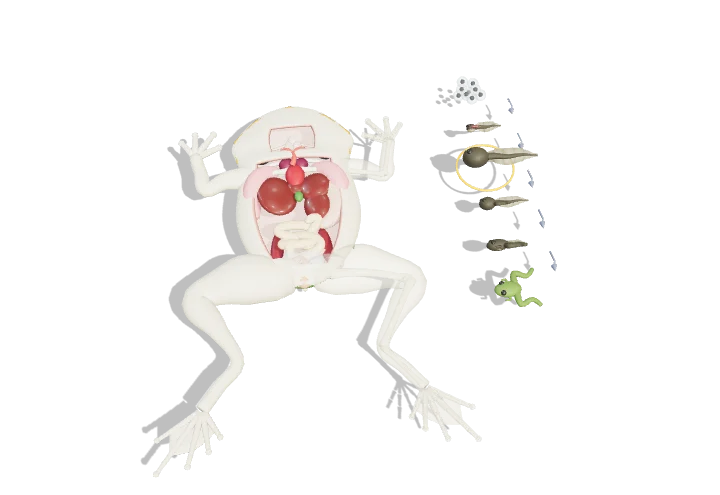
How does a swimming, plant-eating tadpole turn into a jumping, insect-eating frog?
A frog starts life in water as a tadpole that breathes with gills and nibbles algae. Over a few months, a hormone rebuilds almost its whole body: legs grow, the tail disappears, lungs start working and the gut changes to digest insects. The adult breathes with its lungs and through its damp skin.
A frog is a tetrapod built for two worlds: as a larva it breathes with gills and grazes in water, and after a hormone-driven metamorphosis it becomes an air-breathing, jumping carnivore. Its anatomy — a three-chambered heart, buccal-pumped lungs, breathing skin, a short spine with a long urostyle and powerful hind limbs — reflects that amphibious life.
Key facts
- Species shown
- Common frog, Rana temporaria
- Adult size
- Snout–vent length ≈ 6–9 cm
- Heart
- 3 chambers: 2 atria, 1 ventricle
- Vertebrae
- 9 (8 presacral + 1 sacral) plus the urostyle
- Development
- 46 Gosner stages; ≈ 10–16 weeks egg to froglet in R. temporaria
- Respiratory surfaces
- Lungs, skin and the lining of the mouth
Parts you can explore (11)
- Skin and body wall
- Heart
- Lungs
- Liver and gall bladder
- Stomach
- Intestines
- Kidneys
- Urinary bladder
- Brain
- Skeleton
- Metamorphosis stages
In the 3D model
Rotate and take apart the model, follow a guided tour of what each part does and why it’s needed, change it with a live slider, and test yourself with a short quiz. Free, no sign-up.
OpenArc Models’ models are simplified teaching schematics. Terms · Privacy