Power & energy
Four-stroke engine
Engines · Inline-4 petrol (Otto cycle)
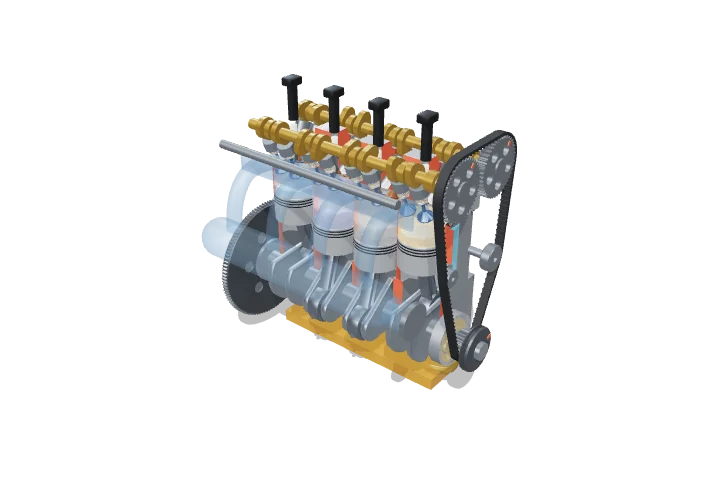 Open the interactive 3D model →
What actually happens inside a car engine thousands of times a minute?
A car engine burns tiny squirts of petrol mixed with air inside metal cylinders. Each burst of hot gas shoves a piston down, and connecting rods turn those pushes into the spinning of a crankshaft that drives the wheels. Every cylinder repeats the same four steps, called strokes: suck in, squeeze, burn and push out.
A four-stroke petrol engine turns the chemical energy of fuel into shaft work by repeating intake, compression, power and exhaust strokes in every cylinder, one cycle per two crank revolutions. In this inline-four the cylinders fire 1-3-4-2, one every 180°, while belt-driven camshafts at half crank speed open sixteen valves at precisely timed moments.
Key facts
- Cycle
- 4 strokes in 720° of crank rotation
- Model geometry
- bore 86 mm × stroke 86 mm → 2.0 L
- Compression ratio (model)
- 10.5 : 1
- Firing order / interval
- 1-3-4-2, every 180°
- Ideal Otto efficiency at r = 10.5
- ≈ 61% (real brake efficiency ≈ 30–38%)
- Camshaft speed
- ½ crankshaft speed (22 : 44 teeth)
Parts you can explore (16)
- Engine block
- Water jacket
- Pistons
- Connecting rods
- Crankshaft
- Flywheel
- Cylinder head
- Camshafts
- Valves
- Timing belt
- Spark plugs
- Fuel injectors
- Intake manifold
- Exhaust manifold
- Oil sump and pump
- Combustion gases
In the 3D model
Rotate and take apart the model, follow a guided tour of what each part does and why it’s needed, change it with a live slider, and test yourself with a short quiz. Free, no sign-up.
Open Four-stroke engine in 3D →
OpenArc Models’ models are simplified teaching schematics. Terms · Privacy