Human body
Foot skeleton and arches
Anatomy · Foot biomechanics
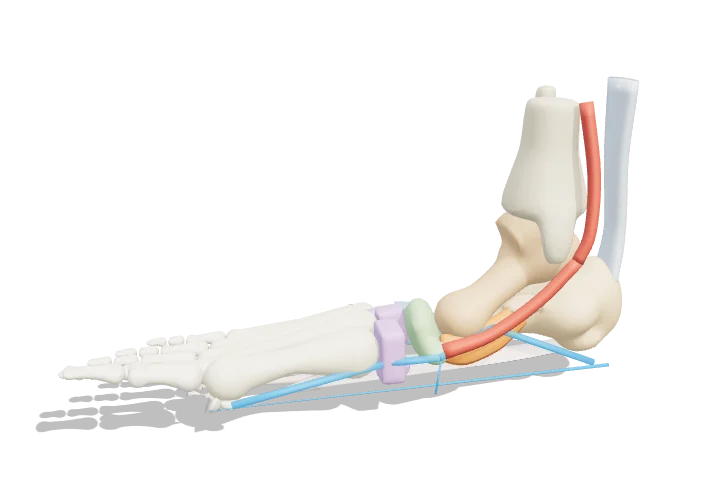 Open the interactive 3D model →
How does a foot made of 26 small bones carry your whole weight with every step?
The bones of your foot form an arch, like a stone bridge, with the heel at one end and the ball of the foot at the other. When you stand the arch sags a few millimetres to soak up the shock, and when you push off it stiffens so the foot works like a firm lever.
The 26 bones of the foot form a sprung, arched structure that spreads body weight between the heel and the metatarsal heads, flattens slightly to absorb load and stiffens into a rigid lever for push-off. Bone shape, ligaments such as the spring ligament, muscles such as tibialis posterior and the plantar fascia — tightened by toe extension through the windlass mechanism — all hold the arch up.
Key facts
- Bones per foot
- 26 (7 tarsals, 5 metatarsals, 14 phalanges) + 2 hallux sesamoids
- Arches
- 3: medial longitudinal, lateral longitudinal, transverse
- Navicular height (standing)
- ≈ 3.5–4.5 cm above the floor
- Navicular drop, sitting → standing
- ≈ 5–9 mm normal; > 10 mm suggests excessive pronation
- Peak plantar fascia tension
- ≈ 1 × body weight in late stance
- Calcaneal pitch angle
- ≈ 18–30° on a weight-bearing lateral radiograph
Parts you can explore (13)
- Calcaneus
- Talus
- Navicular
- Cuboid
- Cuneiforms
- Metatarsals
- Phalanges
- Tibia and fibula
- Plantar fascia
- Achilles tendon
- Spring ligament
- Tibialis posterior tendon
- Medial longitudinal arch
In the 3D model
Rotate and take apart the model, follow a guided tour of what each part does and why it’s needed, change it with a live slider, and test yourself with a short quiz. Free, no sign-up.
Open Foot skeleton and arches in 3D →
OpenArc Models’ models are simplified teaching schematics. Terms · Privacy