Power & energy
Flywheel energy storage
Mechanics · Energy storage
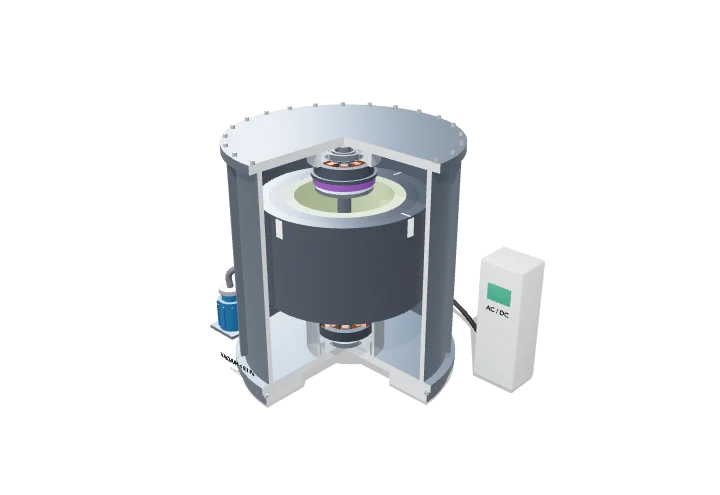 Open the interactive 3D model →
Can you store electricity by spinning a wheel really, really fast?
A flywheel stores energy as motion: an electric motor spins a ring faster and faster, and the spinning ring holds that energy. When electricity is needed, the same machine works as a generator, and the ring slows down as it gives the energy back. It floats on magnets inside a vacuum, so it keeps spinning with very little energy lost.
A flywheel stores energy as the rotational kinetic energy ½Iω² of a rotor, which a motor-generator speeds up to charge and slows down to discharge. Modern units use light, strong composite rims spinning at tens of thousands of rpm on magnetic bearings in a vacuum, giving fast response, very long cycle life and high power for short durations.
Key facts
- Stored energy
- E = ½Iω² (∝ speed squared)
- Rotor speed (composite)
- ≈ 10,000–50,000 rpm
- Rim speed limit
- ≈ 600–1000 m/s for carbon fibre
- Round-trip efficiency
- ≈ 85–95 % over minutes
- Cycle life
- > 100,000 full cycles
- Typical duration
- Seconds to ≈ 15 minutes at rated power
Parts you can explore (9)
- Vacuum enclosure
- Composite rotor
- Hub and shaft
- Axial magnetic bearing
- Radial magnetic bearings
- Touchdown bearings
- Motor-generator
- Vacuum pump
- Power converter
In the 3D model
Rotate and take apart the model, follow a guided tour of what each part does and why it’s needed, change it with a live slider, and test yourself with a short quiz. Free, no sign-up.
Open Flywheel energy storage in 3D →
OpenArc Models’ models are simplified teaching schematics. Terms · Privacy