Plants & animals
Flower
Plant biology · Reproduction
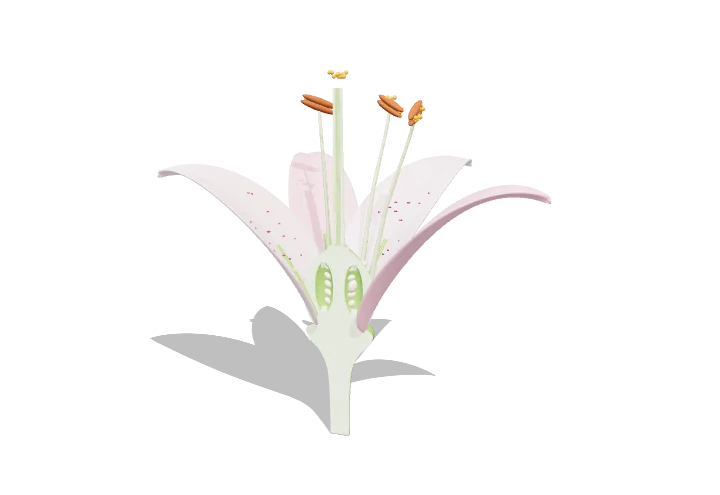 Open the interactive 3D model →
How does a speck of pollen on a flower turn into a seed you could plant?
A flower is a plant’s way of making seeds. Pollen from one flower lands on the sticky tip of another, then grows a tiny tube down inside to reach an egg. When the pollen’s sperm joins the egg, the egg becomes a seed and the part around it swells into a fruit.
A flower is a short shoot of modified leaves arranged in whorls — sepals, petals, stamens and carpels — specialised for sexual reproduction in angiosperms. After pollen reaches the stigma, a pollen tube delivers two sperm cells to an ovule, where double fertilisation produces both the embryo and its endosperm food store.
Key facts
- Lily floral formula
- ✶ P3+3 A3+3 G(3) — radial, 6 tepals, 6 stamens, superior ovary of 3 fused carpels
- Pollen-tube growth rate
- ≈ 1–4 mm per hour in lily; up to ≈ 1 cm per hour in maize
- Embryo sac (Polygonum type, most species)
- 7 cells, 8 nuclei
- Endosperm ploidy
- 3n in most species; 5n in lilies (Fritillaria-type embryo sac)
- Angiosperm species
- ≈ 300,000 described
- Lily style length
- ≈ 5–12 cm, so tubes take 1–2 days to reach the ovules
Parts you can explore (12)
- Sepals
- Petals
- Nectaries
- Filaments
- Anthers
- Pollen grains
- Stigma
- Style
- Ovary
- Ovules
- Pollen tube
- Receptacle
In the 3D model
Rotate and take apart the model, follow a guided tour of what each part does and why it’s needed, change it with a live slider, and test yourself with a short quiz. Free, no sign-up.
OpenArc Models’ models are simplified teaching schematics. Terms · Privacy