Power & energy
Vanadium redox flow battery
Electrochemistry · Grid energy storage
 Open the interactive 3D model →
Could you store a town’s electricity in giant tanks of coloured liquid?
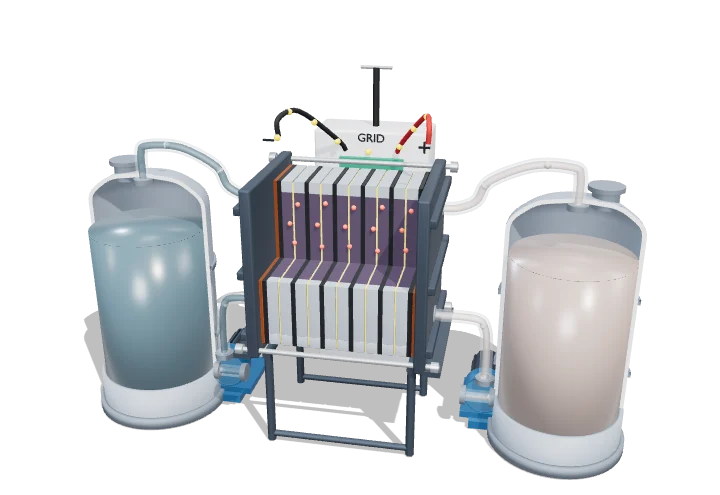
A flow battery keeps its energy in two big tanks of liquid instead of inside sealed cells. Pumps push the liquids through a stack of thin cells, where electricity changes the dissolved metal (vanadium) to store energy, and changing it back gives the energy out again. To store more energy you simply use bigger tanks.
A vanadium redox flow battery stores energy in two tanks of vanadium electrolyte that are pumped through a stack of cells, where the vanadium ions are oxidised and reduced on carbon-felt electrodes separated by an ion-exchange membrane. Because the active material is dissolved rather than built into the electrodes, energy capacity (tank volume) and power (stack area) are sized independently, which suits long-duration grid storage.
Key facts
- Standard cell potential
- E° ≈ 1.26 V; ≈ 1.4 V at 50 % SOC in practice
- Electrolyte
- 1.5–2 M vanadium in 2–5 M H₂SO₄
- Energy density
- ≈ 15–25 Wh per litre of electrolyte
- Round-trip efficiency
- ≈ 65–80 % (AC to AC, including pumps)
- Cycle life
- > 10,000 cycles; design life 20+ years
- Operating temperature
- ≈ 10–40 °C
Parts you can explore (12)
- Stack frame and end plates
- Current collectors
- Bipolar plates
- Carbon felt electrodes
- Ion-exchange membrane
- Electrolyte tanks
- Negative electrolyte (V²⁺/V³⁺)
- Positive electrolyte (VO²⁺/VO₂⁺)
- Pumps
- Piping
- Power conversion system
- Protons (H⁺)
In the 3D model
Rotate and take apart the model, follow a guided tour of what each part does and why it’s needed, change it with a live slider, and test yourself with a short quiz. Free, no sign-up.
Open Vanadium redox flow battery in 3D →
OpenArc Models’ models are simplified teaching schematics. Terms · Privacy