Cells & molecules
Bacterial flagellar motor
Microbiology · Molecular machine
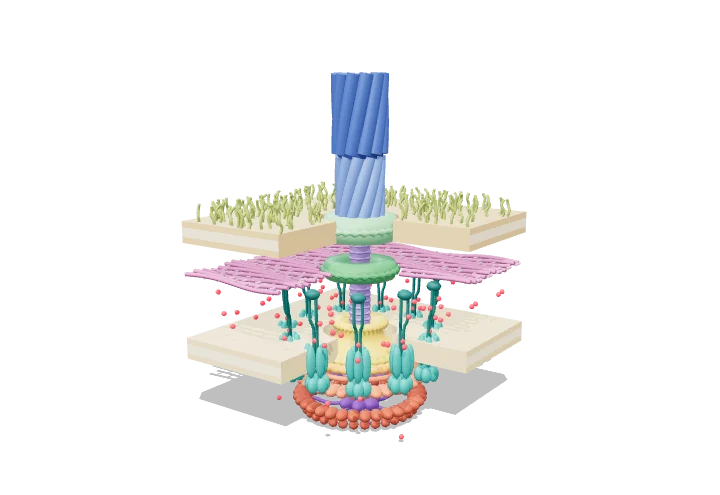 Open the interactive 3D model →
How does a bacterium swim when it has no muscles — and can reverse in a thousandth of a second?
Many bacteria swim using a long, stiff, corkscrew-shaped tail. At its base sits a rotary motor only about 45 nm across, built into the cell’s wall, that spins the corkscrew like a ship’s propeller. It runs not on ATP but on a flow of charged particles (protons) into the cell, pushed by a difference in charge and acidity across the membrane.
The bacterial flagellar motor is a reversible rotary engine about 45 nm across, embedded in the cell envelope and powered by ions flowing down the proton-motive force. Stator units fixed to the cell wall push on a rotor of rings, turning a rod, a flexible hook and a long helical filament that propels the cell.
Key facts
- Rotor (C ring) diameter
- ≈ 45 nm (E. coli)
- Speed
- ≈ 100–300 rev/s (E. coli, H⁺); up to ≈ 1,700 rev/s (Vibrio, Na⁺)
- Stall torque
- ≈ 1,300 pN nm
- Stator units
- up to ≈ 11 per motor, exchanging dynamically
- Filament
- ≈ 20 nm wide, 5–10 µm long, ~20,000 flagellin subunits
- Steps per revolution
- ≈ 26 (observed at low speed)
Parts you can explore (14)
- C ring
- MS ring
- Rod
- P ring
- L ring
- Hook
- Filament
- Stator units
- Proton flow
- Export apparatus
- CheY-P
- Inner membrane
- Peptidoglycan
- Outer membrane
In the 3D model
Rotate and take apart the model, follow a guided tour of what each part does and why it’s needed, change it with a live slider, and test yourself with a short quiz. Free, no sign-up.
Open Bacterial flagellar motor in 3D →
OpenArc Models’ models are simplified teaching schematics. Terms · Privacy