Plants & animals
Fish anatomy
Vertebrates · Bony fish
 Open the interactive 3D model →
How does a fish breathe underwater, and how does it float without sinking or rising?
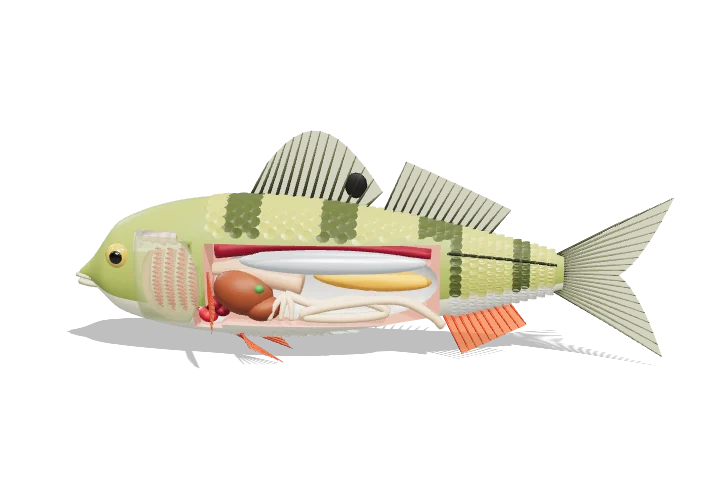
A fish swims by bending its body in a wave from head to tail, and uses its fins to steer and stay upright. It breathes by pumping water over its gills, which pull oxygen out of the water into its blood. A bag of gas inside, the swim bladder, lets it hover in the water without effort.
The European perch is a typical spiny-rayed bony fish (teleost): a streamlined body driven by a wave of muscle contraction, steered by median and paired fins, and kept neutrally buoyant by a gas-filled swim bladder. Inside, countercurrent gills ventilated by a buccal–opercular pump supply oxygen to a single circulation driven by a two-chambered heart.
Key facts
- Species modelled
- European perch, Perca fluviatilis (Actinopterygii: Teleostei)
- Typical adult length
- ≈ 15–35 cm (record ≈ 60 cm)
- Gill arches
- 4 per side, each with two rows of filaments
- Heart
- 2 chambers (atrium, ventricle) plus sinus venosus and bulbus arteriosus
- Swim bladder
- Closed (physoclistous); ≈ 7% of body volume in freshwater fish, ≈ 5% in marine fish
- Cruising stride
- ≈ 0.6–0.8 body lengths per tail beat
Parts you can explore (16)
- Dorsal fins
- Caudal fin
- Anal fin
- Pectoral and pelvic fins
- Operculum
- Gills
- Heart
- Liver
- Stomach
- Intestines
- Swim bladder
- Kidney
- Gonads
- Lateral line
- Body, skin and scales
- Brain
In the 3D model
Rotate and take apart the model, follow a guided tour of what each part does and why it’s needed, change it with a live slider, and test yourself with a short quiz. Free, no sign-up.
OpenArc Models’ models are simplified teaching schematics. Terms · Privacy