Fluids & heat
Fire-tube boiler
Heat transfer · Steam generation
 Open the interactive 3D model →
How does a hospital or brewery turn a gas flame into tonnes of steam an hour without the boiler exploding?
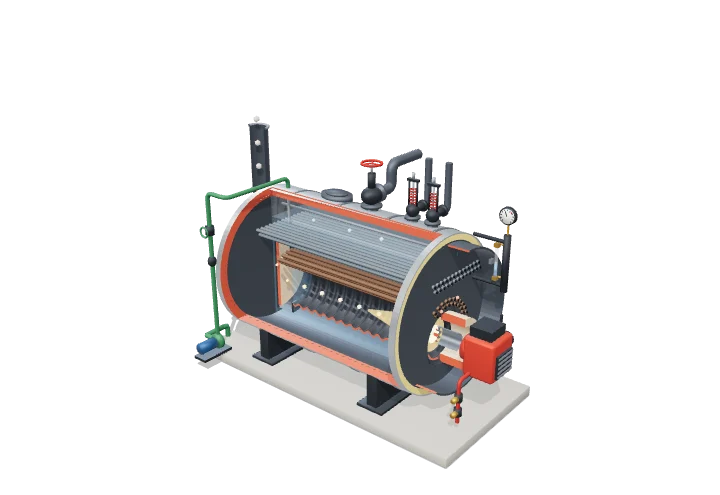
A fire-tube boiler is a big steel drum full of water with a flame tube and lots of smaller pipes running through it. Hot gas from the flame flows through the pipes, and the water around them boils into steam. Gauges, a water pump and safety valves keep the water level and pressure safe.
A fire-tube boiler passes hot combustion gases through a furnace and banks of tubes immersed in a large shell of water, which boils to produce saturated steam. The three-pass wetback Scotch marine design is the standard packaged boiler for factories, hospitals and district heating, typically making 1–25 tonnes of steam per hour at around 10 bar.
Key facts
- Typical output
- ≈ 1–25 t/h of saturated steam
- Working pressure
- commonly 7–17 bar g (≈ 30 bar max)
- Saturation temperature
- ≈ 184 °C at 10 bar g
- Flue-gas temperatures
- ≈ 1,600 °C flame → ≈ 200 °C at the stack
- Fuel-to-steam efficiency
- ≈ 85–90% (higher with an economiser)
- Smoke tubes
- ≈ 50–75 mm outside diameter
Parts you can explore (15)
- Shell
- Insulation & cladding
- Furnace
- Reversal chamber
- Second-pass tubes
- Third-pass tubes
- Smokeboxes & stack
- Water space
- Steam space
- Burner
- Flue gas
- Safety valves
- Main steam valve
- Water-level gauge
- Feedwater
In the 3D model
Rotate and take apart the model, follow a guided tour of what each part does and why it’s needed, change it with a live slider, and test yourself with a short quiz. Free, no sign-up.
OpenArc Models’ models are simplified teaching schematics. Terms · Privacy