Fluids & heat
Fire sprinkler system
Fire protection · Wet-pipe sprinklers
 Open the interactive 3D model →
If you burn toast, why don’t all the sprinklers in the building go off at once?
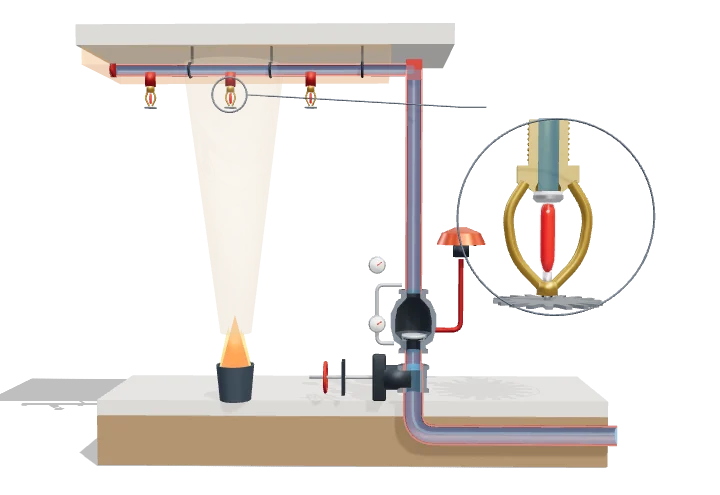
Each sprinkler is a separate little tap, plugged by a small glass bulb full of coloured liquid. When hot air from a fire heats the bulb, the liquid swells until the glass bursts, and water sprays out — only from the heads above the fire. Smoke alone does nothing; it takes real heat.
An automatic sprinkler system is a network of water-filled pipes closed at each outlet by a heat-operated valve: a glass bulb (or fusible link) that fails at a set temperature, releasing water that a deflector spreads over the fire. Only the heads heated by the fire open, and each discharges a flow fixed by its K-factor and the water pressure, Q = K√p.
Key facts
- Bulb ratings
- orange 57 °C, red 68 °C, yellow 79 °C, green 93 °C, blue 141 °C
- Standard K-factor
- K80 L/min/bar^½ (K5.6 gpm/psi^½), ½ in thread
- Bulb diameter
- 5 mm standard response, 3 mm quick response
- Response Time Index
- quick ≤ 50 (m·s)^½; standard ≥ 80 (m·s)^½
- Minimum head pressure
- ≈ 0.5 bar (7 psi) in NFPA 13
- Coverage per head
- ≈ 9–21 m² depending on hazard and head type
Parts you can explore (15)
- Ceiling and floor
- Branch line
- Sprinkler heads
- Riser
- Alarm valve
- Control valve
- Water supply main
- Water motor gong
- Fire and hot gas layer
- Frame and orifice
- Cap and seal
- Glass bulb
- Deflector
- Water spray
- Callout
In the 3D model
Rotate and take apart the model, follow a guided tour of what each part does and why it’s needed, change it with a live slider, and test yourself with a short quiz. Free, no sign-up.
Open Fire sprinkler system in 3D →
OpenArc Models’ models are simplified teaching schematics. Terms · Privacy