Plants & animals
Fern life cycle
Plants · Ferns
 Open the interactive 3D model →
Ferns have no flowers and no seeds — so where do new ferns come from?
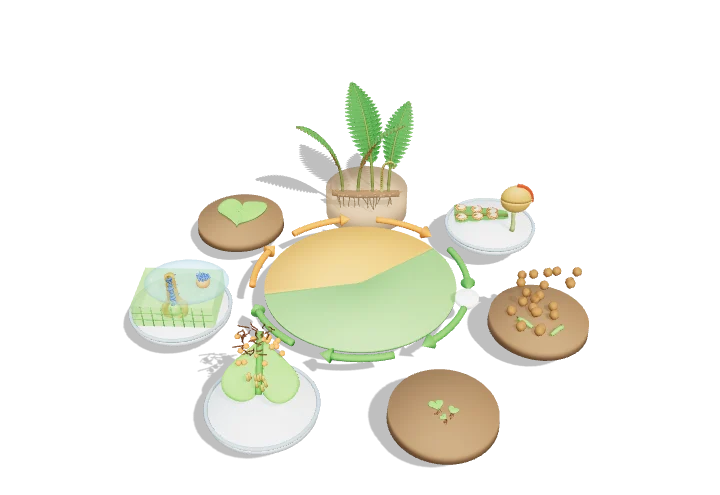
A fern lives two different lives. The big leafy plant makes millions of dust-like spores under its leaves, and each spore grows into a tiny heart-shaped plant smaller than your fingernail. That little plant makes swimming sperm and an egg, and when they join, a new big fern grows out of it.
Ferns alternate between a large, long-lived diploid sporophyte with roots, rhizome and fronds and a tiny, free-living haploid gametophyte called the prothallus. Sporangia on the fronds make spores by meiosis and fling them out with a spring-like annulus; each spore grows into a prothallus whose swimming sperm fertilise an egg to start the next sporophyte.
Key facts
- Dominant generation
- Diploid sporophyte (2n)
- Gametophyte
- Free-living heart-shaped prothallus, ≈ 3–8 mm across
- Spores per sporangium
- Typically 64 (16 spore mother cells × 4)
- Spore ejection speed
- Up to ≈ 10 m/s (annulus catapult)
- Vascular tissue
- Xylem and phloem in the sporophyte only
- Species
- ≈ 10,500 living ferns
Parts you can explore (16)
- Life-cycle ring
- Spores
- Prothallus
- Rhizoids
- Antheridia
- Archegonia
- Sperm
- Egg and zygote
- Young sporophyte
- Rhizome
- Roots
- Fronds
- Fiddlehead
- Sori
- Sporangia
- Annulus
In the 3D model
Rotate and take apart the model, follow a guided tour of what each part does and why it’s needed, change it with a live slider, and test yourself with a short quiz. Free, no sign-up.
OpenArc Models’ models are simplified teaching schematics. Terms · Privacy