Human body
Female reproductive system
Anatomy · Reproductive system
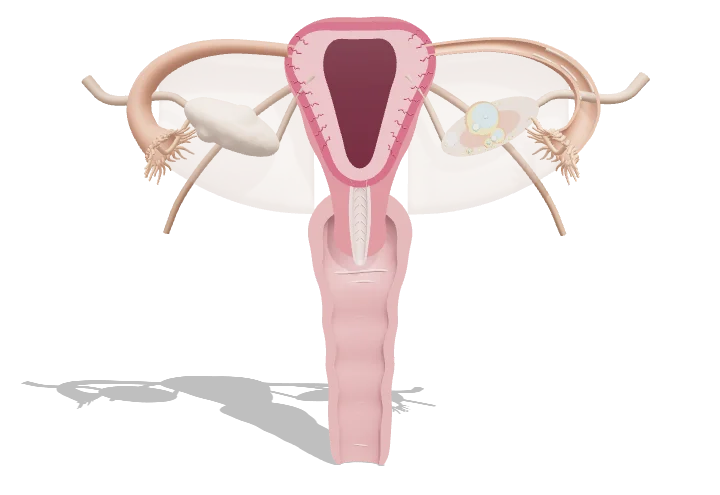 Open the interactive 3D model →
What actually happens inside the body during a menstrual cycle, and why does it repeat about every 28 days?
The ovaries hold thousands of tiny egg sacs called follicles. About once a month, hormones ripen one follicle until it releases an egg, which is swept into a uterine tube toward the uterus. Meanwhile the uterus builds a thick lining ready for a pregnancy; if none starts, the lining is shed as a period and the cycle begins again.
The ovaries produce oocytes and the steroid hormones oestradiol and progesterone, while the uterine tubes, uterus, cervix and vagina transport gametes and support a pregnancy. Each ovarian cycle — follicle growth, ovulation and the corpus luteum — is mirrored by a uterine cycle in which the endometrium thickens and is shed.
Key facts
- Uterus (non-pregnant)
- ≈ 7.5 × 5 × 2.5 cm; ≈ 40–80 g
- Uterine tube length
- ≈ 10–12 cm
- Ovary size
- ≈ 3 × 1.5 × 1 cm
- Cycle length
- 28 days typical; 21–35 days normal range
- Pre-ovulatory follicle
- ≈ 18–25 mm diameter
- Primordial follicles
- ≈ 1–2 million at birth; ≈ 300 000–400 000 at puberty
Parts you can explore (15)
- Fundus
- Myometrium
- Endometrium
- Uterine cavity
- Cervix
- Vagina
- Uterine tubes
- Fimbriae
- Ovaries
- Ovarian follicles
- Corpus luteum
- Oocyte
- Broad ligament
- Ovarian & suspensory ligaments
- Round ligament
In the 3D model
Rotate and take apart the model, follow a guided tour of what each part does and why it’s needed, change it with a live slider, and test yourself with a short quiz. Free, no sign-up.
Open Female reproductive system in 3D →
OpenArc Models’ models are simplified teaching schematics. Terms · Privacy