Mechanisms
FDM 3D printer
Mechanisms · Additive manufacturing
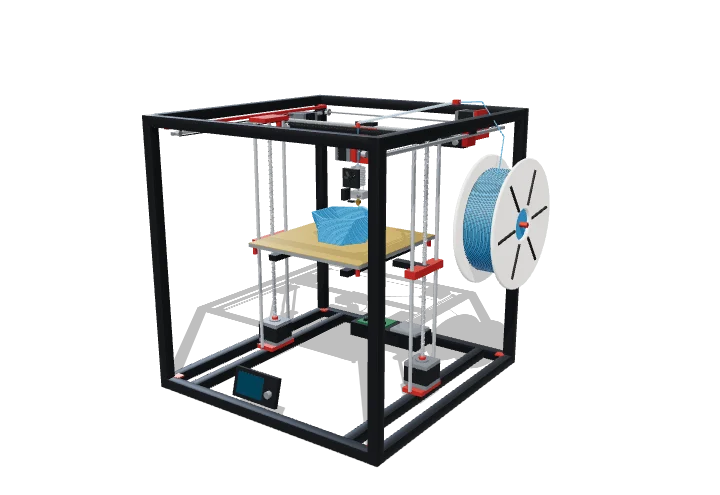 Open the interactive 3D model →
How can a machine turn a reel of plastic string into a solid vase, one hair-thin line at a time?
A 3D printer pushes plastic string, called filament, into a tiny hot nozzle where it melts. Motors steer the nozzle around while it squeezes out a thin line of melted plastic, which cools and sets almost at once. Layer by layer, each one stacked on the last, the object grows from the bottom up.
A fused deposition modelling (FDM) printer builds a part by melting thermoplastic filament and laying it down as thin beads, one layer at a time, along paths generated by slicing software. Stepper motors with belts and leadscrews position the nozzle, while closed-loop heaters keep the hot end and bed at their set temperatures.
Key facts
- Filament diameter
- 1.75 mm (also 2.85 mm)
- Nozzle bore
- typically 0.4 mm
- Layer height
- typically 0.1–0.3 mm (model: 0.2 mm, drawn 10 layers at a time)
- PLA temperatures
- hot end ≈ 190–220 °C, bed ≈ 50–65 °C
- X/Y drive
- GT2 belt, 20-tooth pulley: 40 mm per turn
- Z drive
- T8 leadscrew: 8 mm per turn
Parts you can explore (13)
- Frame
- Y axis
- X gantry
- Extruder
- Hot end
- Nozzle
- Heater cartridge
- Thermistor
- Heated bed
- Z axis
- Filament spool
- Electronics
- Printed part
In the 3D model
Rotate and take apart the model, follow a guided tour of what each part does and why it’s needed, change it with a live slider, and test yourself with a short quiz. Free, no sign-up.
OpenArc Models’ models are simplified teaching schematics. Terms · Privacy