Power & energy
Sodium-cooled fast breeder reactor
Nuclear power · Generation IV fast reactor
 Open the interactive 3D model →
Can a nuclear reactor make more fuel than it burns?
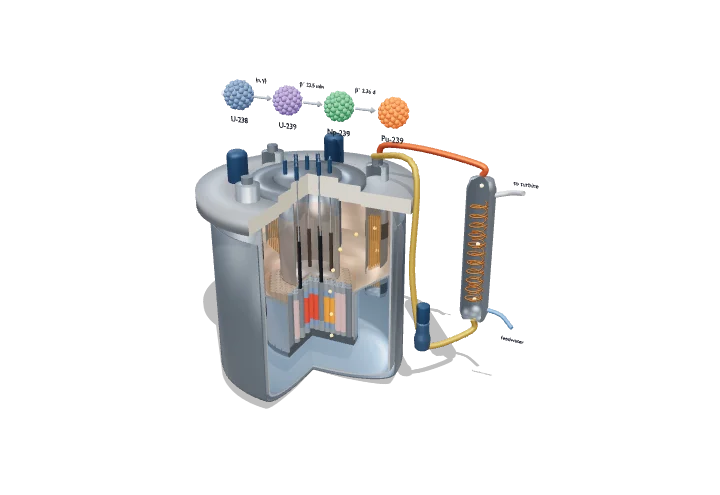
Almost all natural uranium is a kind that hardly ever splits, so ordinary reactors use less than 1% of it. A fast breeder reactor keeps its neutrons, the tiny particles that split atoms, moving very fast, so each split releases enough spare neutrons to turn that unused uranium into new fuel called plutonium. It is cooled by liquid sodium metal, which carries the heat away without slowing the neutrons down.
A sodium-cooled fast reactor sustains its chain reaction with unmoderated fast neutrons in a compact plutonium–uranium oxide (MOX) core, cooled by liquid sodium in a large pool at near-atmospheric pressure. Because fast fission of plutonium yields about three neutrons, spare neutrons can convert fertile U-238 in a surrounding blanket into Pu-239, producing as much or more fissile material than the reactor consumes.
Key facts
- Neutron spectrum
- fast, mean energy ≈ 0.1–0.5 MeV; no moderator
- Fuel
- MOX, ≈ 15–30% PuO₂ in UO₂ (or metal U-Pu-Zr alloy)
- Coolant
- liquid sodium, ≈ 395 °C in, ≈ 545 °C out, ≈ 0.1 MPa
- Breeding ratio
- ≈ 1.1–1.3 for breeder cores; < 1 for burner cores
- Superphénix (1986–1998)
- 3000 MWt → 1200 MWe (η ≈ 40%)
- Sodium boiling point
- 883 °C at atmospheric pressure
Parts you can explore (14)
- Main and guard vessels
- Roof and rotating plugs
- Redan
- Hot sodium pool
- Cold sodium pool
- MOX core
- Radial blanket (U-238)
- Control rods and above-core structure
- Intermediate heat exchangers
- Primary pumps
- Secondary sodium loop
- Steam generator
- Sodium flow
- Breeding chain
In the 3D model
Rotate and take apart the model, follow a guided tour of what each part does and why it’s needed, change it with a live slider, and test yourself with a short quiz. Free, no sign-up.
Open Sodium-cooled fast breeder reactor in 3D →
OpenArc Models’ models are simplified teaching schematics. Terms · Privacy