Physics
Faraday’s law of induction
Electromagnetism · Induction
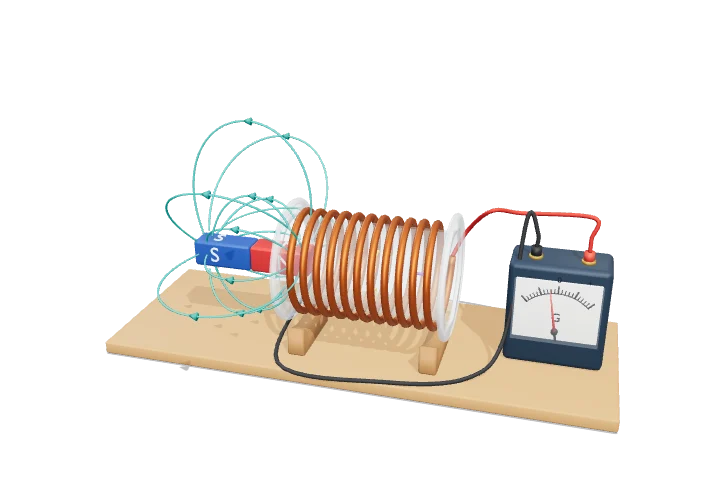 Open the interactive 3D model →
How can waving a magnet near a loop of wire make electricity with no battery at all?
When a magnet moves near a coil of wire, its changing magnetic field pushes electric charges around the wire, so a current flows. The faster the magnet moves, the bigger the current. A magnet that just sits still makes no current at all.
A changing magnetic flux through a circuit induces an EMF equal to minus the rate of change of flux linkage, ε = −N dΦ/dt. Moving a bar magnet in and out of a coil makes that change visible on a centre-zero galvanometer, and Lenz’s law fixes the direction of the resulting current.
Key facts
- Faraday’s law
- ε = −N dΦ_B/dt
- Unit of flux
- 1 weber (Wb) = 1 T m² = 1 V s
- Model coil
- 200 turns, radius 2.25 cm (11 turns drawn)
- Model magnet
- B_r ≈ 1.2 T, 12 mm × 12 mm pole face
- Peak EMF in this model
- ≈ 27 mV at 0.10 m/s; ≈ 80 mV at 0.30 m/s
- Discovered
- Michael Faraday, 29 August 1831
Parts you can explore (10)
- Bar magnet
- Magnetic field lines
- Coil windings
- Coil former
- Galvanometer
- Needle and scale
- Connecting leads
- Induced current
- Induced field (Lenz)
- Base board
In the 3D model
Rotate and take apart the model, follow a guided tour of what each part does and why it’s needed, change it with a live slider, and test yourself with a short quiz. Free, no sign-up.
Open Faraday’s law of induction in 3D →
OpenArc Models’ models are simplified teaching schematics. Terms · Privacy