Astronomy & space
Falcon 9
Spaceflight · Reusable launch vehicle
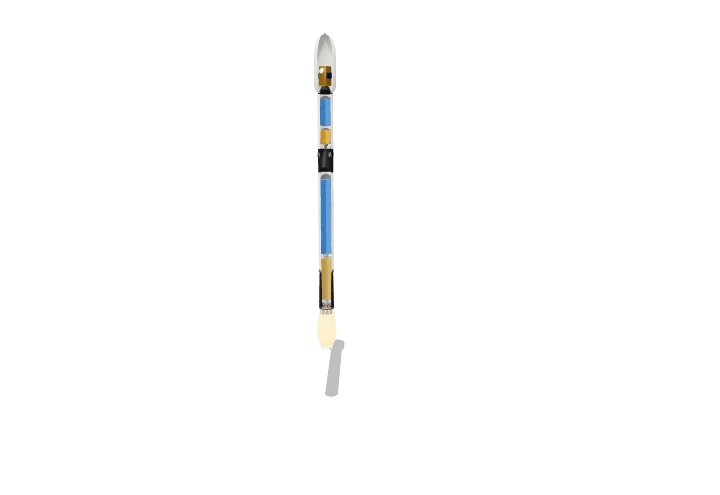 Open the interactive 3D model →
How does a 40-metre rocket booster fall back from space and land upright on a pad?
Falcon 9 is a two-part rocket. The big bottom part, the first stage, pushes the rocket up for about two and a half minutes and then separates, while the smaller second stage carries the satellite on into orbit. Instead of falling into the sea, the first stage turns around, fires its engines to slow down, steers with fins and lands on legs so it can fly again.
Falcon 9 is a two-stage, kerosene–liquid-oxygen launch vehicle whose first stage routinely returns to land on a pad or drone ship for reuse. Its design — nine identical engines on the booster, one vacuum-optimised engine on the upper stage, grid fins and deployable legs — shows how staging, propellant choice and propulsive landing fit together.
Key facts
- Height × diameter
- ≈ 70 m × 3.7 m (fairing 5.2 m)
- Liftoff mass
- ≈ 549 t
- Liftoff thrust
- ≈ 7.6 MN from nine Merlin 1D engines
- Payload to LEO
- ≈ 22.8 t expended; less when the booster is recovered
- Propellants
- RP-1 kerosene + liquid oxygen, both densified (sub-cooled)
- First booster landing
- 21 December 2015 (Landing Zone 1, Cape Canaveral)
Parts you can explore (12)
- First stage
- First-stage propellant tanks
- Merlin 1D engines
- Interstage
- Grid fins
- Landing legs
- Second stage
- Merlin Vacuum engine
- Payload fairing
- Payload
- Engine exhaust
- Landing pad
In the 3D model
Rotate and take apart the model, follow a guided tour of what each part does and why it’s needed, change it with a live slider, and test yourself with a short quiz. Free, no sign-up.
OpenArc Models’ models are simplified teaching schematics. Terms · Privacy