Astronomy & space
Exoplanet transit
Astronomy · Exoplanet detection
 Open the interactive 3D model →
How can we find a planet around another star when it is far too small and faint to see?
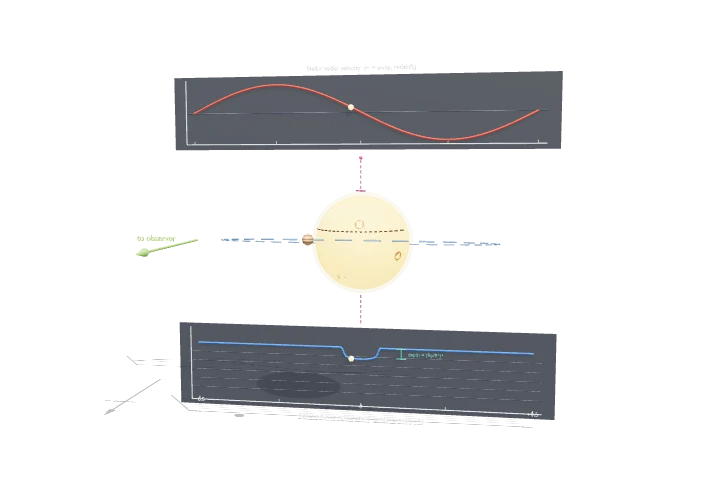
When a planet passes in front of its star, it blocks a tiny bit of the starlight, so the star dims slightly for a few hours. Telescopes measure that small, regular dip in brightness, and the size of the dip tells us how big the planet is. The planet also tugs its star into a tiny wobble, which tells us how heavy the planet is.
When a planet’s orbit is aligned with our line of sight, it passes in front of its star once per orbit and blocks a fraction (Rp/R*)² of the starlight. Combining this transit signal with the star’s radial-velocity wobble gives the planet’s radius, mass and density.
Key facts
- Transit depth
- ΔF ≈ (Rp/R*)²
- Jupiter across the Sun
- ≈ 1.0% dip
- Earth across the Sun
- ≈ 84 ppm dip, ≈ 13 h duration
- Transit probability
- ≈ R*/a (≈ 0.5% for Earth at 1 AU)
- Sun’s reflex speed due to Jupiter
- ≈ 12.5 m/s (period 11.9 yr)
- Known exoplanets
- > 6,000 confirmed (2025), most found by transits
Parts you can explore (10)
- Host star
- Transiting planet
- Planet orbit
- Transit chord
- Light curve
- Transit depth
- Line of sight to Earth
- Barycentre axis
- Stellar reflex orbit
- Radial-velocity curve
In the 3D model
Rotate and take apart the model, follow a guided tour of what each part does and why it’s needed, change it with a live slider, and test yourself with a short quiz. Free, no sign-up.
Open Exoplanet transit in 3D →
OpenArc Models’ models are simplified teaching schematics. Terms · Privacy