Power & energy
Electric car drivetrain
Automotive · Battery electric
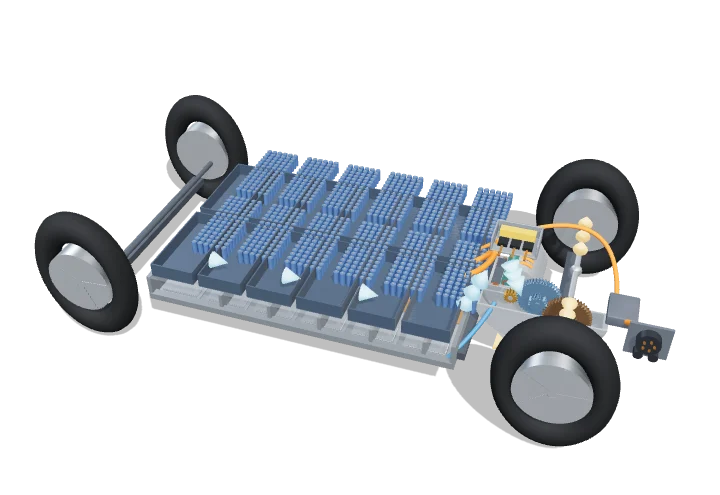 Open the interactive 3D model →
How does an electric car reach motorway speed without ever changing gear?
An electric car carries a flat battery, made of thousands of small cells, under its floor. An electronic box called the inverter turns the battery’s steady current into alternating current that spins an electric motor, which drives the wheels through one simple set of gears. When you slow down, the motor works in reverse as a generator and puts energy back into the battery.
A battery-electric car stores energy in a flat lithium-ion pack under the floor and converts it to motion with an inverter, a permanent-magnet motor and a single fixed reduction gear. The same chain runs in reverse during regenerative braking, and a battery management system and liquid cooling keep the thousands of cells safe and long-lived.
Key facts
- Pack energy (mid-size car)
- ≈ 55–100 kWh
- Pack voltage
- ≈ 350–400 V (some 800 V platforms)
- Motor peak power
- ≈ 150–300 kW per drive unit
- Reduction ratio
- ≈ 8–10 : 1, single speed
- Battery-to-wheel efficiency
- ≈ 85–90 %
- Energy use
- ≈ 14–20 kWh per 100 km
Parts you can explore (13)
- Battery modules
- Cooling plates
- Battery pack enclosure
- Battery management system
- Inverter
- Permanent-magnet motor
- Reduction gear
- Differential
- Rear wheels and half shafts
- Front wheels
- Charging port
- High-voltage cables
- Power flow
In the 3D model
Rotate and take apart the model, follow a guided tour of what each part does and why it’s needed, change it with a live slider, and test yourself with a short quiz. Free, no sign-up.
Open Electric car drivetrain in 3D →
OpenArc Models’ models are simplified teaching schematics. Terms · Privacy