Plants & animals
Euglena
Protists · Euglenozoa
 Open the interactive 3D model →
Can something be a plant and an animal at the same time?
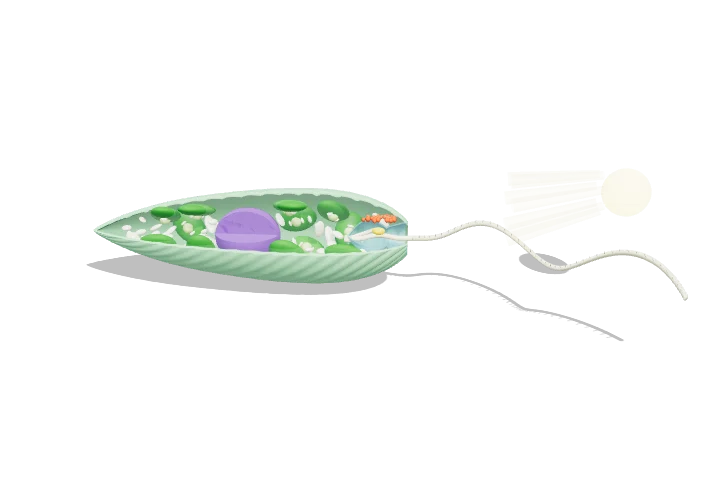
Euglena is a single cell, about a twentieth of a millimetre long, that lives in ponds. It is green and makes food from sunlight like a plant, but it also swims with a whip-like tail and can eat dissolved food in the dark like an animal. It even steers towards gentle light and away from light that is too bright.
Euglena gracilis is a single-celled euglenozoan protist that photosynthesises with chloroplasts acquired by secondary endosymbiosis, yet swims with a flagellum and can live heterotrophically in the dark. A blue-light photoreceptor at the base of its flagellum, shaded by a pigmented eyespot as the cell rolls, lets it steer towards moderate light and away from harmful bright light.
Key facts
- Cell length
- ≈ 35–60 µm (width ≈ 8–15 µm)
- Classification
- Euglenozoa · Euglenida (relatives of trypanosomes)
- Chloroplasts
- ≈ 10–20 per cell, three envelope membranes
- Storage carbohydrate
- Paramylon (β-1,3-glucan)
- Photoreceptor
- Photoactivated adenylyl cyclase in the paraflagellar body
- Nutrition
- Mixotrophic: photosynthesis plus uptake of organic compounds
Parts you can explore (11)
- Pellicle
- Cytoplasm
- Reservoir
- Flagellum
- Photoreceptor
- Eyespot
- Contractile vacuole
- Nucleus
- Chloroplasts
- Paramylon granules
- Light source
In the 3D model
Rotate and take apart the model, follow a guided tour of what each part does and why it’s needed, change it with a live slider, and test yourself with a short quiz. Free, no sign-up.
OpenArc Models’ models are simplified teaching schematics. Terms · Privacy