Chemistry
Ethene and the π bond
Organic chemistry · Bonding
 Open the interactive 3D model →
Why can one end of a single bond spin freely, while a double bond locks a molecule in place?
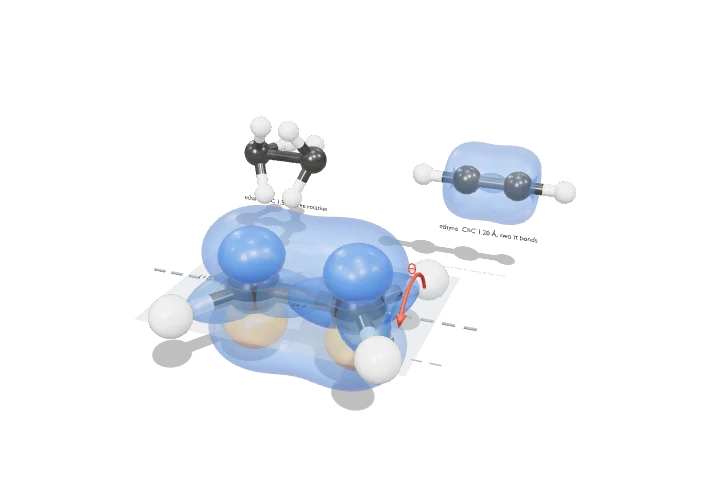
Ethene is a small, flat molecule: two carbon atoms joined by a double bond, each holding two hydrogens. One of the two bonds runs straight between the carbons; the other forms from clouds that overlap side by side, above and below the molecule. Twist one end and those clouds stop overlapping — so the second bond breaks.
In ethene each carbon is sp² hybridised: three in-plane hybrids form a planar σ framework, and the leftover parallel 2p orbitals overlap side by side to form a π bond above and below the molecular plane. Because π overlap depends on the two p orbitals staying parallel, twisting the molecule about the C=C axis destroys the π bond, which is why double bonds are rigid and give cis/trans isomers.
Key facts
- C=C bond length
- 1.34 Å (ethane C–C 1.54 Å, ethyne C≡C 1.20 Å)
- C–H bond length
- 1.09 Å
- Bond angles
- H–C–H 117.4°, H–C=C 121.3° (ideal sp² 120°)
- C=C bond enthalpy
- ≈ 728 kJ mol⁻¹ (σ ≈ 450 + π ≈ 270)
- Cis/trans rotation barrier
- ≈ 272 kJ mol⁻¹ (thermal isomerisation of 1,2-dideuterioethene)
- π → π* absorption
- λ_max ≈ 165 nm (far UV)
Parts you can explore (12)
- Carbon atoms (sp²)
- Hydrogen atoms
- σ-bond framework
- p orbitals
- π bond (upper lobe)
- π bond (lower lobe)
- sp² hybrid orbitals
- Bond-angle markers
- Nodal plane
- Twist axis
- Ethane (comparison)
- Ethyne (comparison)
In the 3D model
Rotate and take apart the model, follow a guided tour of what each part does and why it’s needed, change it with a live slider, and test yourself with a short quiz. Free, no sign-up.
Open Ethene and the π bond in 3D →
OpenArc Models’ models are simplified teaching schematics. Terms · Privacy