Fluids & heat
Espresso machine
Fluid flow · Heat and pressure
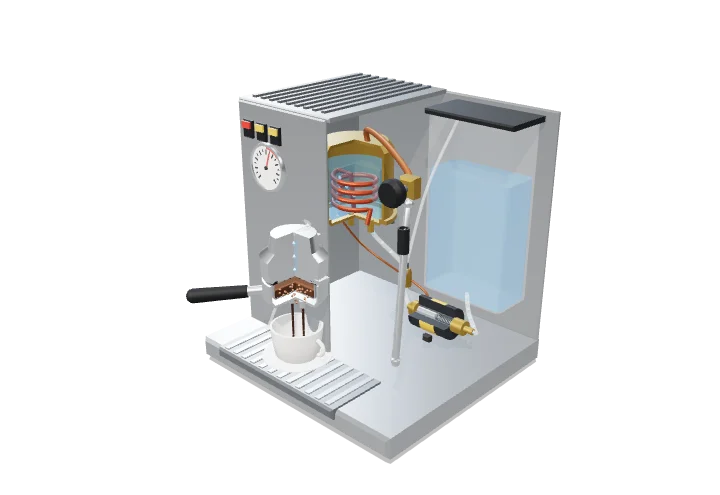 Open the interactive 3D model →
Why does espresso need a machine that pushes water nine times harder than the air around us?
An espresso machine heats water to just below boiling and pumps it hard through a small, tightly packed cake of finely ground coffee. The coffee is packed so tightly that water only trickles through, picking up flavour on the way. How fast it trickles decides whether the coffee tastes sour, balanced or bitter.
An espresso machine forces water at about 93 °C and 9 bar through a compacted bed of finely ground coffee, dissolving roughly a fifth of the coffee’s mass in under half a minute. The puck behaves as a porous medium, so Darcy’s law links brew pressure to flow rate, and flow rate in turn controls contact time and extraction.
Key facts
- Brew pressure
- ≈ 9 bar (8–10 bar typical)
- Brew water temperature
- ≈ 90–96 °C
- Typical double shot
- 18 g coffee → ≈ 36 g espresso in ≈ 25–30 s
- Target extraction yield
- ≈ 18–22 % of the dry coffee mass
- Espresso strength (TDS)
- ≈ 8–12 % dissolved solids
- Vibratory pump maximum
- ≈ 15 bar against a closed outlet
Parts you can explore (14)
- Casing
- Water reservoir
- Vibratory pump
- Boiler
- Heating element
- Grouphead
- Portafilter
- Coffee puck
- Drip tray and cup
- Steam wand
- Pressure gauge
- Three-way solenoid valve
- Over-pressure valve
- Water circuit
In the 3D model
Rotate and take apart the model, follow a guided tour of what each part does and why it’s needed, change it with a live slider, and test yourself with a short quiz. Free, no sign-up.
OpenArc Models’ models are simplified teaching schematics. Terms · Privacy