Mechanisms
Escalator
Machines · Chain drives and linkages
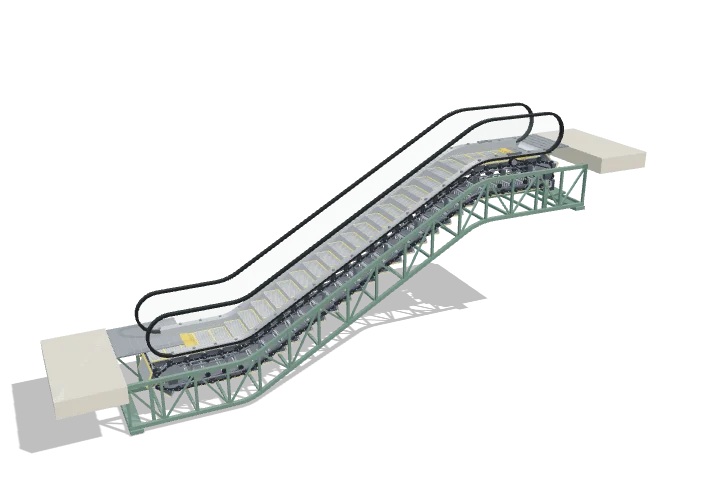 Open the interactive 3D model →
Where do escalator steps go when they vanish into the floor — and how do they stay level?
An escalator is a long loop of steps pulled round by two chains, like a bicycle chain with stairs bolted on. Each step has two pairs of wheels running on two separate rails, and the height gap between the rails keeps every step flat for your feet. At the top the steps slide under the floor, turn over, and ride back down upside down.
An escalator is a closed loop of steps carried on two roller chains: each step has a chain axle and a trailing-wheel axle running on separate tracks, and the spacing between those tracks keeps every tread level on the incline and flattens the steps at the landings. A motor at the upper landing pulls the loaded run up through sprockets while a matched handrail moves alongside.
Key facts
- Model
- 3.6 m rise at 30°, 1.0 m steps, 60 steps
- Step pitch
- 0.40 m (three 133 mm chain links)
- Riser height on the incline
- 0.40 × sin 30° = 0.20 m
- Typical speed
- 0.5 m/s (up to 0.75 m/s)
- Theoretical capacity, 1.0 m at 0.5 m/s
- 9,000 people/h
- Standard inclinations
- 30° or 35° (35° only for low rise and speed)
Parts you can explore (12)
- Steps
- Step chain
- Step tracks
- Truss
- Drive sprockets
- Return station
- Drive machine
- Balustrade
- Handrail
- Handrail drive
- Comb plates
- Landing plates
In the 3D model
Rotate and take apart the model, follow a guided tour of what each part does and why it’s needed, change it with a live slider, and test yourself with a short quiz. Free, no sign-up.
OpenArc Models’ models are simplified teaching schematics. Terms · Privacy