Cells & molecules
Enzyme catalysis
Biochemistry · Enzymes
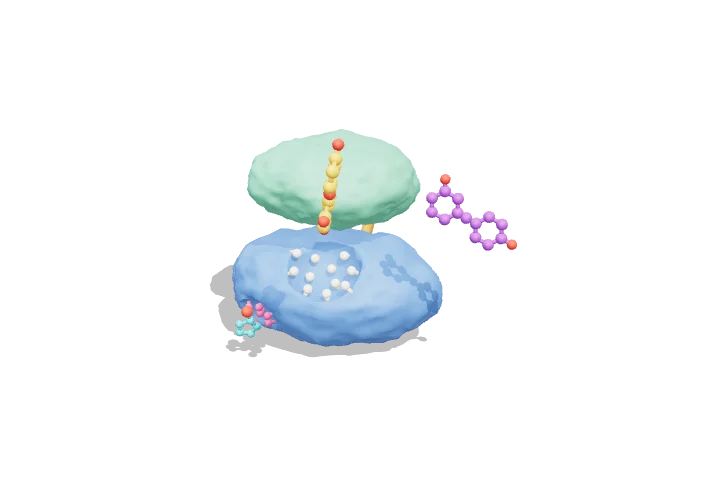 Open the interactive 3D model →
Why do reactions that would take years in a bottle finish in milliseconds inside you?
Enzymes are proteins that speed up chemical reactions. Each one has a pocket shaped to hold a particular molecule, and holding it in just the right position makes the reaction far easier. The enzyme is not used up: it lets the products go and starts again, often thousands of times a second.
Enzymes are protein catalysts that speed reactions by binding the transition state more tightly than the substrate, lowering the activation energy without changing the equilibrium. Their rate depends on substrate concentration in a saturating way described by the Michaelis–Menten equation, and it can be tuned by inhibitors and allosteric effectors.
Key facts
- Typical rate enhancement
- 10⁶–10¹⁷-fold over the uncatalysed reaction
- Typical kcat
- ≈ 1–10⁴ s⁻¹ (most enzymes ≈ 10 s⁻¹)
- Typical Km
- ≈ 10⁻⁶–10⁻² M
- Diffusion limit for kcat/Km
- ≈ 10⁸–10⁹ M⁻¹ s⁻¹
- Hexokinase I Km for glucose
- ≈ 0.03–0.1 mM (glucokinase ≈ 8–10 mM)
- Model parameters
- Vmax = 100 µM/s, Km = 2 mM (illustrative)
Parts you can explore (9)
- Large domain
- Small domain
- Hinge
- Active site
- Substrate
- Transition state
- Products
- Competitive inhibitor
- Allosteric site
In the 3D model
Rotate and take apart the model, follow a guided tour of what each part does and why it’s needed, change it with a live slider, and test yourself with a short quiz. Free, no sign-up.
OpenArc Models’ models are simplified teaching schematics. Terms · Privacy