Power & energy
Single-cylinder engine
Thermal · Four-stroke petrol (Otto cycle)
 Open the interactive 3D model →
How does a tiny burst of burning petrol make a wheel turn, thousands of times a minute?
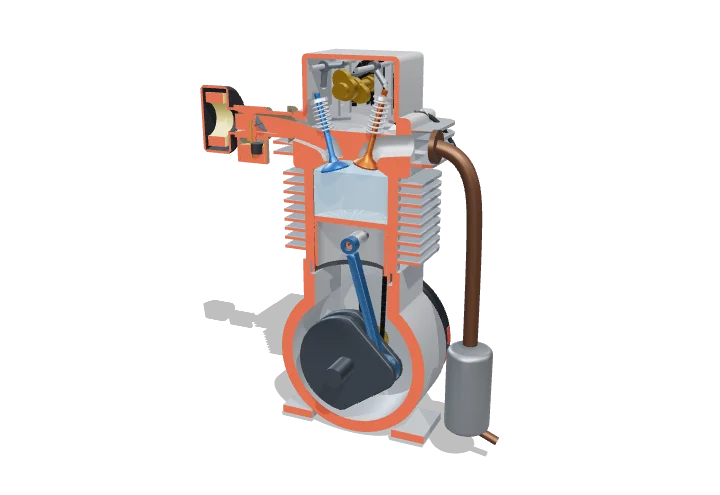
Inside this engine a piston slides up and down in a cylinder. Burning a squeezed mix of fuel and air above it pushes it down hard, and a crank turns that push into spinning. Valves let fresh mixture in and burnt gas out, so the job repeats every two turns.
A four-stroke spark-ignition engine turns the chemical energy of a fuel–air charge into shaft work by burning it at high pressure above a piston, approximating the air-standard Otto cycle. A slider-crank mechanism converts the piston’s back-and-forth motion into rotation, and a half-speed camshaft opens the valves so that one cycle takes two crank revolutions.
Key facts
- This engine
- bore 65 mm × stroke 60 mm = 199 cm³, compression ratio 9.5
- Cycle length
- 720° of crank rotation = 4 strokes = 1 power stroke
- Ideal Otto efficiency at r = 9.5
- ≈ 59% (γ = 1.4)
- Real brake efficiency
- ≈ 20–30% for small air-cooled singles; up to ≈ 40% for modern car engines
- Peak cylinder pressure
- ≈ 4–7 MPa (40–70 bar) at full load
- Stoichiometric air–fuel ratio
- ≈ 14.7 : 1 by mass (petrol)
Parts you can explore (12)
- Cylinder & crankcase
- Cooling fins
- Head & valves
- Camshaft & timing chain
- Piston
- Connecting rod
- Crankshaft
- Flywheel
- Spark plug
- Carburettor & intake
- Exhaust
- Combustion gases
In the 3D model
Rotate and take apart the model, follow a guided tour of what each part does and why it’s needed, change it with a live slider, and test yourself with a short quiz. Free, no sign-up.
Open Single-cylinder engine in 3D →
OpenArc Models’ models are simplified teaching schematics. Terms · Privacy