Cells & molecules
Clathrin-mediated endocytosis
Cell biology · Membrane traffic
 Open the interactive 3D model →
How does a cell take in something too big to fit through any of its doors?
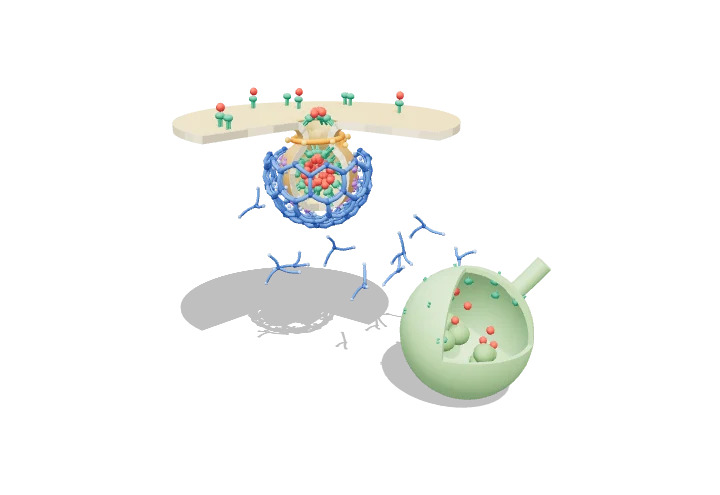
Cells can swallow material by wrapping a patch of their own surface around it and pinching it off as a tiny bubble. To do this, proteins gather the things to be taken in, then a cage of three-legged protein units builds over the patch and curves it into a pit. A ring-shaped protein squeezes the neck of the pit until the bubble breaks free and carries its load into the cell.
Clathrin-mediated endocytosis is the main route by which animal cells take up specific receptors and their bound cargo from the cell surface. Adaptors link cargo to a self-assembling clathrin lattice that bends the membrane into a pit, dynamin pinches it off, and the uncoated vesicle delivers its contents to early endosomes for sorting.
Key facts
- Coated vesicle diameter
- ≈ 60–120 nm (cage); ≈ 40–80 nm membrane
- Triskelion
- 3 heavy chains (≈ 190 kDa) + 3 light chains (≈ 25 kDa); legs ≈ 50 nm
- Coated-pit lifetime
- ≈ 30–90 s from initiation to scission
- Pentagons per closed cage
- exactly 12 (with a variable number of hexagons)
- Dynamin
- ≈ 100 kDa GTPase; forms a helix ≈ 50 nm wide around the neck
- Early endosome pH
- ≈ 6.0–6.5
Parts you can explore (8)
- Plasma membrane
- Receptors & cargo
- AP2 adaptors
- Clathrin coat
- Dynamin
- Coated vesicle
- Hsc70 & auxilin
- Early endosome
In the 3D model
Rotate and take apart the model, follow a guided tour of what each part does and why it’s needed, change it with a live slider, and test yourself with a short quiz. Free, no sign-up.
Open Clathrin-mediated endocytosis in 3D →
OpenArc Models’ models are simplified teaching schematics. Terms · Privacy