Human body
Endocrine system
Anatomy · Endocrine system
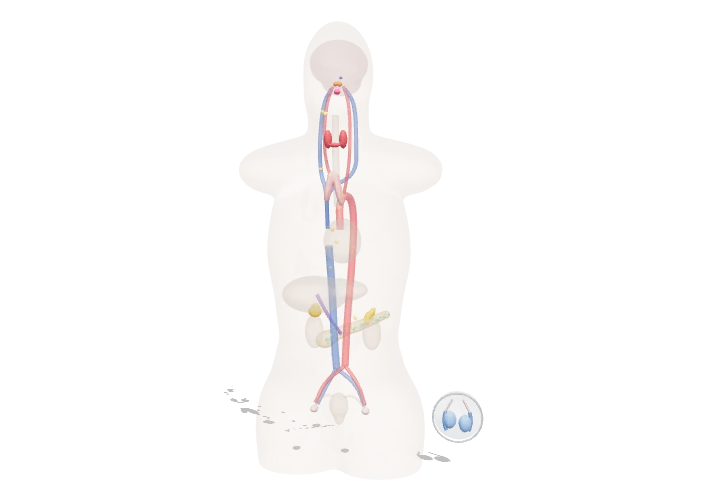 Open the interactive 3D model →
How does a tiny gland in your head tell organs far down in your body what to do?
Endocrine glands release chemical messengers called hormones straight into your blood. The blood carries them everywhere, but only cells with the right receptor respond, a bit like a radio tuned to one station. Most hormone levels are kept steady by feedback: when there is enough, the gland that makes it is told to slow down.
The endocrine system is a set of ductless glands that secrete hormones into the blood to regulate metabolism, growth, reproduction, stress responses and the internal environment. Most hormone levels are held near a set point by negative feedback, often through hierarchical axes in which the hypothalamus controls the pituitary, which in turn controls a target gland.
Key facts
- Pituitary mass
- ≈ 0.5–1 g
- Thyroid mass, adult
- ≈ 15–25 g
- Pancreatic islets
- ≈ 1 million (≈ 1–2% of pancreatic mass)
- Plasma cortisol, morning
- ≈ 140–690 nmol/L (≈ 5–25 µg/dL), lowest near midnight
- Thyroid output
- ≈ 80–100 µg T₄/day; ≈ 80% of T₃ comes from peripheral conversion of T₄
- Fasting blood glucose
- ≈ 3.9–5.5 mmol/L (70–100 mg/dL)
Parts you can explore (15)
- Body outline
- Context organs
- Hypothalamus
- Pituitary gland
- Pineal gland
- Thyroid gland
- Parathyroid glands
- Thymus
- Adrenal glands
- Pancreas
- Pancreatic islets
- Ovaries
- Testes
- Bloodstream
- Hormones
In the 3D model
Rotate and take apart the model, follow a guided tour of what each part does and why it’s needed, change it with a live slider, and test yourself with a short quiz. Free, no sign-up.
OpenArc Models’ models are simplified teaching schematics. Terms · Privacy