Chemistry
Electron configuration (aufbau, Hund, Pauli)
Atomic structure · Periodic table
 Open the interactive 3D model →
Why do sodium and potassium both explode in water, while neon and argon do nothing at all?
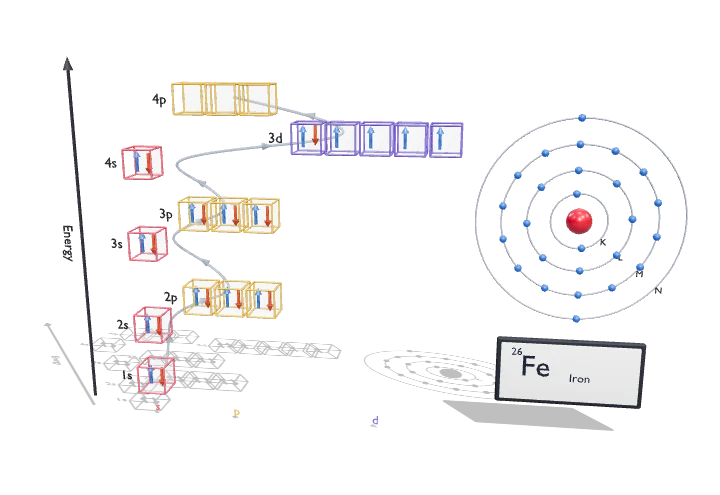
Electrons in an atom live in “boxes” called orbitals, and each box holds at most two. They fill the lowest-energy boxes first, spreading out before they double up. The way the outermost boxes end up filled decides how an element behaves — which is why the periodic table repeats.
The ground-state electron configuration of an atom lists how its electrons occupy orbitals, built up by adding electrons to the lowest available orbital (aufbau), spreading them with parallel spins over orbitals of equal energy (Hund) and allowing at most two opposite-spin electrons per orbital (Pauli). These rules explain the shape of the periodic table, from its s, p and d blocks to the anomalous configurations of chromium and copper.
Key facts
- Electrons per orbital
- 2 (opposite spins, Pauli principle)
- Orbitals per subshell
- 2l + 1: s 1, p 3, d 5, f 7
- Electrons per shell
- 2n²: K 2, L 8, M 18, N 32
- Filling order (n + l rule)
- 1s 2s 2p 3s 3p 4s 3d 4p 5s 4d 5p 6s 4f …
- Anomalies in Z ≤ 36
- Cr [Ar] 3d⁵ 4s¹; Cu [Ar] 3d¹⁰ 4s¹
- Most unpaired electrons (Z ≤ 36)
- Cr: 6 (3d⁵ 4s¹)
Parts you can explore (12)
- 1s subshell
- 2s subshell
- 2p subshell
- 3s subshell
- 3p subshell
- 4s subshell
- 3d subshell
- 4p subshell
- Energy axis
- Aufbau order path
- Shell model
- Element plaque
In the 3D model
Rotate and take apart the model, follow a guided tour of what each part does and why it’s needed, change it with a live slider, and test yourself with a short quiz. Free, no sign-up.
Open Electron configuration (aufbau, Hund, Pauli) in 3D →
OpenArc Models’ models are simplified teaching schematics. Terms · Privacy